
A pervasive and often uncritical narrative has taken hold in boardrooms and policy circles: an aging workforce is a drag on productivity. This assumption, rooted in ageist stereotypes and a narrow definition of economic contribution, frames demographic aging as an inevitable crisis of dependency and decline. It is time to dismantle this flawed premise. A growing body of empirical research reveals a more complex and promising reality. While aging presents undeniable challenges, it does not inherently equate to lower productivity. In fact, when supported by adaptive institutions and intelligent management, a multi-generational workforce featuring a significant proportion of older employees can offer a powerful “maturity dividend”—a composite of experience, stability, and social capital that is increasingly valuable in a volatile, skills-hungry economy. The key to unlocking this potential lies not in pushing older workers out, but in rethinking the very architecture of work to harness their distinct and complementary strengths.
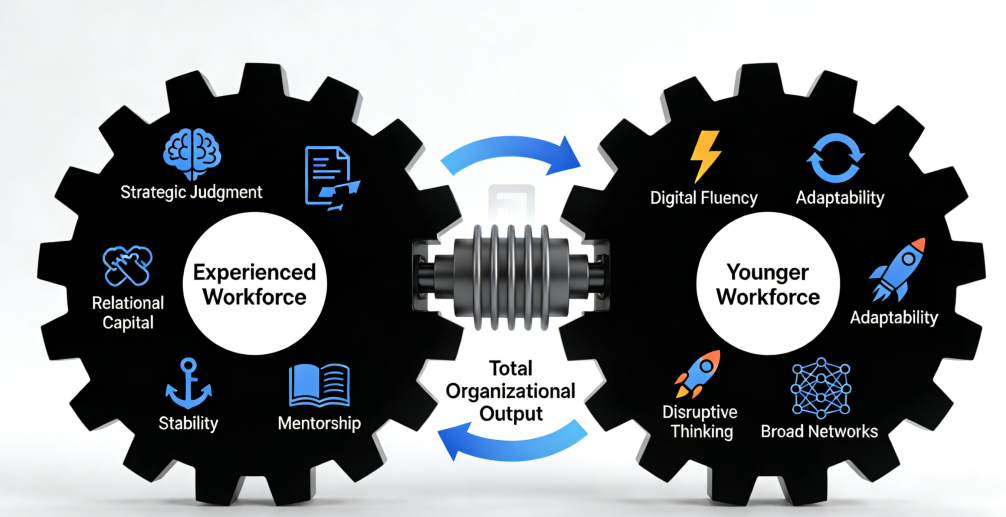
The core myth—that cognitive and physical decline uniformly erodes workplace value—collapses under scrutiny. While some fluid cognitive abilities (like raw processing speed) may modestly decline with age, crystallized intelligence—the repository of knowledge, expertise, and pattern recognition built over a lifetime—remains robust and often increases. This is the domain of strategic judgment, nuanced problem-solving, and what psychologists call “wisdom”: the ability to integrate complex information, manage uncertainty, and navigate social dynamics. In roles requiring complex decision-making, crisis management, or deep institutional knowledge, this experiential advantage is irreplaceable and often peaks in later career stages. Furthermore, research consistently shows that older workers exhibit higher levels of organizational citizenship behavior, lower turnover, and greater engagement, reducing the substantial hidden costs of recruitment, onboarding, and low morale that plague many industries.
Economically, the value proposition of the experienced worker extends beyond individual output to systemic productivity enhancements. One of the most critical, yet hardest-to-measure, contributions is mentorship and knowledge transfer. In an era of rapid technological change, the tacit knowledge held by senior employees—the “why” behind processes, the historical context for decisions, the craft of client relationships—is a vital organizational asset. Their role as mentors accelerates the development of younger colleagues, mitigating skill gaps and preserving institutional memory. This intergenerational transfer is not a cost center; it is an investment in human capital formation that boosts the productivity of entire teams. A workforce stripped of its senior members risks losing this connective tissue, leading to costly errors of repetition and a shallow talent bench.

Another potent economic contribution is stability and relational depth. Older workers often possess deep networks of professional trust and client relationships cultivated over decades. In client-facing and B2B sectors, this relational capital translates directly into customer loyalty, smoother negotiations, and the ability to navigate complex stakeholder environments. Their presence also provides ballast during periods of organizational turbulence, offering a steadying influence that can enhance team cohesion and resilience. This counters the modern economy’s tendency toward excessive turnover and transactional relationships, building the social fabric necessary for long-term, high-value collaboration.
Realizing this dividend, however, requires a deliberate move away from the one-size-fits-all, “always-on” work models designed for a younger, less diverse demographic. The failure to adapt is where potential productivity is lost, not in the capabilities of older workers themselves. Forward-thinking adaptation hinges on three pillars: flexibility, ergonomics, and continuous learning.
First, flexible work design is paramount. Rigid 9-to-5 schedules and blanket return-to-office mandates are often mismatched with the needs and preferences of many older workers. Offering phased retirement, part-time leadership roles, project-based contracts, and hybrid flexibility allows companies to retain critical expertise on terms that sustain high engagement and output. This is not a concession but an optimization, allowing for the focused application of expertise without the burnout associated with unsustainable full-time roles.
Second, investment in ergonomic and technological enablement is essential. Productivity tools should include adaptive technologies—better lighting, voice-to-software, ergonomic workstations—that compensate for sensory or mobility changes. Crucially, technology adoption must be supported by patient, role-relevant training that emphasizes utility over novelty, empowering older workers to leverage new tools rather than feel alienated by them.
Third, a commitment to lifelong, intergenerational learning must replace the outdated model of front-loaded education. Older workers should have structured, respected pathways to update skills, particularly in digital literacy, without stigma. Conversely, reverse mentorship programs, where younger employees tutor seniors on new technologies while gaining strategic insight in return, foster mutual respect and create a dynamic, collaborative culture where knowledge flows in all directions.
Ultimately, the productivity of an aging workforce is not a predetermined outcome but a function of institutional design. Companies that view age through a deficit lens will indeed incur costs—the cost of lost wisdom, unstable teams, and failed succession. Those that adopt a strength-based perspective will unlock a powerful competitive advantage: a workforce that combines the innovation and digital fluency of youth with the judgment, stability, and deep social capital of experience. In a complex global economy, where trust is scarce and disruptive change is constant, these “softer” attributes are becoming the hard currency of sustainable success. The aging workforce is not a problem to be solved, but a reservoir of underutilized value waiting to be intelligently tapped. The future belongs not to the youngest workforce, but to the wisest.







Discuss