
Within the vast and layered chronicles of human history, few corners are as morbidly captivating as Wikipedia’s “List of Unusual Deaths.” This is no record of grand narratives, but rather a catalogue of fate’s ironic, often cruel, twists. Here lies the account of Clement Vallandigham, the American lawyer who, while demonstrating in court how his client might have accidentally fired a fatal shot, managed to shoot and kill himself. Or Garry Hoy, the Canadian attorney who sought to prove the strength of his office tower’s glass by hurling himself against it—only to fall to his death as the panel gave way. Then there is the ancient Greek philosopher Chrysippus, said to have died from laughter after watching his donkey feast on his figs.
This compendium stands as testament to our enduring fascination with improbable ends—stories so strange they border on fiction. For decades, it served merely as a curiosity, a source of grim anecdote. Yet today, this archive documenting life’s fragile contingencies, along with countless other troves of human expression, has found an unanticipated reader: artificial intelligence.
When we marvel at a chatbot’s fluency in poetry, screenwriting, or code debugging, we are hearing echoes of its peculiar education. Large language models such as ChatGPT, Claude, and Gemini are not taught in sterile classrooms with curated textbooks. Instead, they are immersed in the digital phantom of our civilization: a corpus so immense it encompasses everything from Shakespearean sonnets and quantum physics treatises to online quarrels and, indeed, meticulously documented cases of demise by falling tortoises.
This is not merely a technical footnote; it is the secret to their unsettling potency. They learn not just syntax and facts, but the very texture of human imagination—in all its brilliance, beauty, and profound strangeness.
Imagine a novelist—let us call her Elena—staring at a blank page. She is writing a detective story but is stuck on a pivotal plot point: how to devise a murder that appears accidental yet ingeniously conceived. She prompts her AI assistant: “Suggest a unique, ironic, and slightly theatrical cause of death for a character who is a celebrated historian renowned for his meticulous research.”
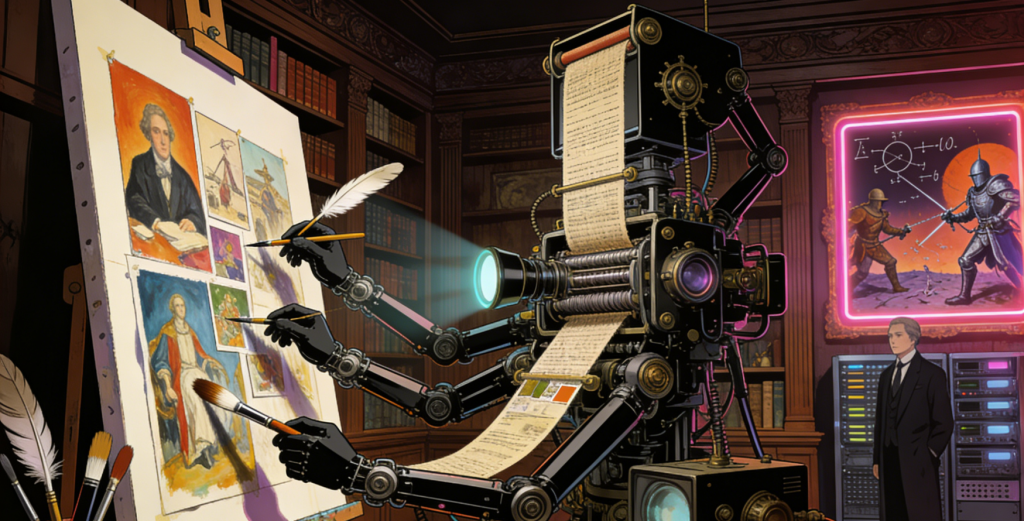
Having absorbed that entire Wikipedia list, the AI does not simply offer “poison” or “blunt force trauma.” It delves into a latent space of possibilities shaped by humanity’s most peculiar moments. It might propose that the historian be crushed beneath a collapsing shelf of rare first editions—a fitting irony. Or perhaps electrocuted by a faulty antique microphone while delivering a lecture on the Luddites—a theatrical twist. It could even invent a scenario of Chrysippus-like absurdity: the historian, obsessed with historical accuracy, attempts to reenact a medieval siege with a replica catapult, only to become its first and sole victim.
These ideas are not born of genuine understanding or conscious creativity. They are statistical reverberations—sophisticated amalgamations of patterns gleaned from vast training data. The AI detected the link between profession and ironic fate in the tale of the window-testing lawyer. It absorbed the narrative force of poetic justice from stories of hubris meeting its end. In a sense, it has read more bizarre obituaries than any human ever could, synthesizing from them the underlying principles of a darkly comedic conclusion.
This is the central paradox of contemporary AI. It functions as a mirror reflecting the totality of our digital output—from our noblest scientific achievements to our most unhinged conspiracy theories. When we prompt an AI, we are not conversing with a mind. We are plucking a string on an instrument of unimaginable complexity, an instrument tuned against the entire symphony of human text. Its creative spark originates in our own, only amplified and remixed at lightning speed.
Yet the instrument’s tuning is profoundly imperfect. If it learns creativity from our strangest tales, it also learns prejudice from our ugliest biases. For every account of bizarre historical happenstance it ingests, it consumes terabytes of text laced with casual racism, entrenched sexism, and systemic injustice. These are not mere anomalies; they are woven into the fabric of the data itself. An AI trained on medical texts from the 1950s may inherit outdated and harmful views on women’s health. One trained on historical legal documents might reflect centuries of baked-in inequality.
The developers behind these models are engaged in a monumental effort of curation and filtration—a process termed “alignment.” They strive to sand down the sharp edges, to instruct the AI to be helpful and harmless. But the task is Herculean, akin to trying to purify an ocean one drop at a time. The machine’s memory is long, its education comprehensive. Traces of the poison inevitably linger.
This leads us to a deeper question. As these systems become further woven into the fabric of our lives—drafting our correspondence, generating our art, shaping the information we consume—what does it mean for our collective consciousness to be molded by a reflection of our entire past, flaws and all? We are building tools that have internalized not only our finest ideas but also our basest instincts. They are libraries housing every luminous insight alongside every shadowed impulse.
Perhaps the greatest lesson the “List of Unusual Deaths” can impart—to us and to our AI progeny—concerns the nature of boundaries. Life is fragile, logic is malleable, and the line between the plausible and the absurd is thinner than we care to admit. These stories stretch our understanding of the possible. For an AI, such data acts as a creative lubricant, preventing its model of the world from becoming too rigid or predictable. It learns that donkeys can inadvertently cause a philosopher’s fatal laughter, that legal arguments can prove lethal, and that the universe operates with a dark, unsparing sense of humor.
In the end, we are not merely teaching our chatbots to write. We are bequeathing to them our entire story—chaotic, contradictory, marked by triumph and folly, boundless creativity and deep-seated flaw. Standing at this technological precipice, gazing at the strange new intelligence we have conjured, we may find it resembles us profoundly—perhaps even more so than we anticipated. And like us, its future will be defined not by the sheer volume of information it holds, but by the wisdom it learns, or fails to learn, to apply.



Discuss