
A persistent fantasy of England endures in collective imagination: a perfectly preserved, honey-hued village nestling in a fold of green hills, seemingly untouched by time. It is a cliché, yet in the Cotswolds Area of Outstanding Natural Beauty, this cliché is made real in stone and history. The village of Castle Combe in Wiltshire is frequently cited as “England’s prettiest village,” a title that, while visually undeniable, risks obscuring the rich, layered reality beneath its photogenic surface. To visit Castle Combe is not merely to step into a postcard; it is to engage with a living lesson in medieval urban planning, socio-economic history, and the conscious preservation of a very particular kind of pastoral heritage.
The following is not a travelogue, but an exploration, breaking down the components that make Castle Combe an exceptional case study in historical integrity.
The Anatomy of a Preserved Village
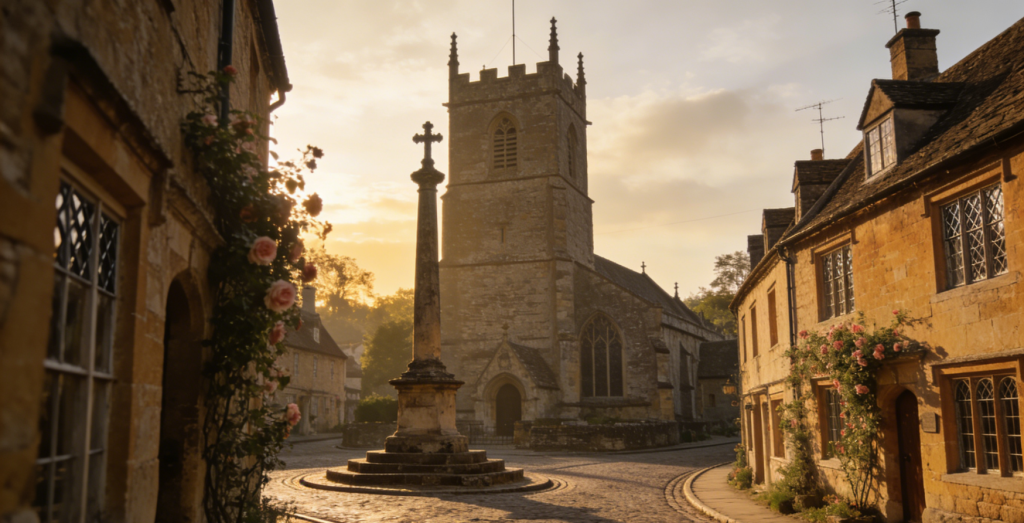
To understand Castle Combe, one must understand its deliberate stasis. Since the 17th century, no new buildings have been erected within its historic core. This self-imposed architectural freeze is the primary reason for its extraordinary state of preservation. The village exists within a hermetic bubble, intentionally free of modern intrusions like street lamps or overhead wires. Every structure is built from the local oolitic limestone, known as Cotswold stone, which weathers to a warm, mellow gold, creating the village’s signature chromatic unity.
Its layout is a masterclass in medieval practicality. The settlement grew around a lucrative wool trade in the 14th century. Rather than a grid, the village follows a single, gently curving main street that descends the valley, functioning as its spine. This street was designed to converge at the Market Cross, the historic commercial and social heart of the community. This layout is not whimsical but pragmatic, shaped by topography and economic flow, creating the intimate, enclosed streetscape that feels so storybook today.
Core Artifacts & Chronological Layers
Castle Combe’s heritage is concentrated in a compact, walkable area where every key feature tells a part of its chronological story.
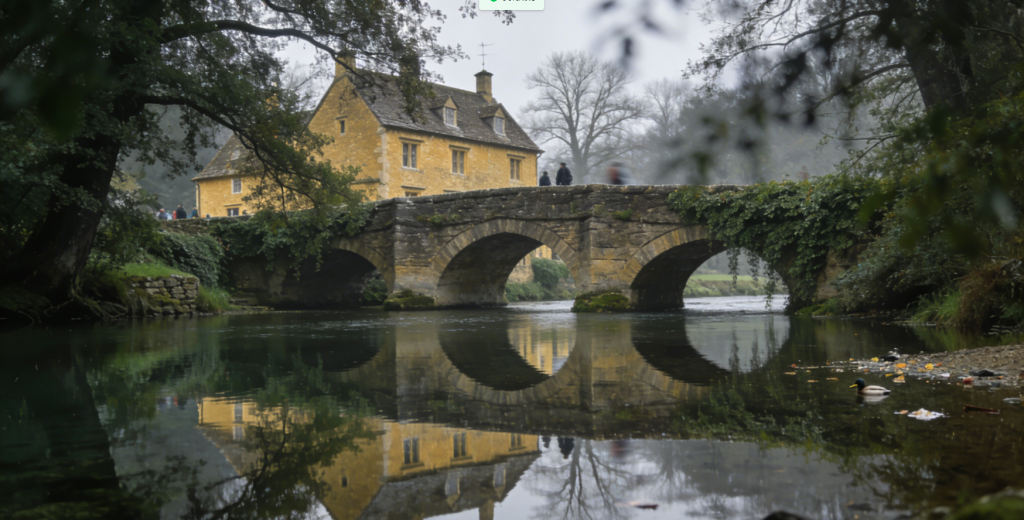
- The Market Cross & The Bybrook River: At the top of the village stands the 14th-century Market Cross. This stone monument is the symbolic anchor, marking the historic marketplace where the village’s wool wealth was generated. A short walk downhill leads to the Bybrook River, crossed by a picturesque 15th-century stone bridge. This bridge represents the village’s connection to the wider world and the practical infrastructure of its past. The sight of the clear water flowing beneath it, often described as a quintessentially English scene, completes the romantic tableau.
- St. Andrew’s Church: Opposite the Market Cross stands the Parish Church of St. Andrew. While the main body dates to the 13th century with 14th- and 16th-century additions, its true treasure is housed in the tower: a 15th-century “faceless” clock. This is one of the oldest working medieval clocks in England, its mechanism telling time without a conventional face, a rare and fascinating artifact of medieval craftsmanship that predates the village’s wool boom.
- The Manor House: On the outskirts lies The Manor House, a grand 14th-century estate set within 365 acres of woodland. Originally the seat of local lords, it now functions as a luxury hotel. Its presence underscores the village’s historical social hierarchy, from the wealthy wool merchants to the manor-owning gentry. Its transition from private estate to hospitality epitomizes how England’s historic buildings adapt for contemporary use.
Cultural Resonance: From Wool to Film
Castle Combe’s charm is not lost on the modern world; it has been meticulously framed for global consumption. Its flawless historic aesthetic has made it a sought-after location for film and television, where it effortlessly stands in for an idealised, timeless England. It has featured in major productions such as Steven Spielberg’s War Horse and the fantasy film Stardust, its reality validating cinematic fiction.
This raises a subtle tension central to its existence. The village is caught between being a lived-in community and a museum-piece. Residents actively resist commercial overdevelopment, with few shops breaking the residential facade, a conscious choice to prioritise atmosphere over tourist revenue. The result is a place that feels authentic not because it is undiscovered, but because its discovery is carefully managed. The fantasy is maintained not by accident, but by collective stewardship.
The Practical Itinerary: A Scholar’s Visit
For the discerning visitor, Castle Combe is best approached as a half-day expedition from nearby hubs like Bath or the transport junction of Chippenham.
| Aspect | Recommendation |
|---|---|
| Best Season | Late Spring or Early Autumn for mild weather and softer light. |
| Itinerary | A half-day visit is sufficient. Start at the Market Cross, proceed down the main street, visit St. Andrew’s Church, cross the 15th-century bridge, and walk along the Bybrook River. |
| Key Focus | Architectural unity, the medieval street plan, the faceless clock, and the contrast between the humble weavers’ cottages and the grand Manor House. |
| Travel Note | The village’s preserved state means amenities are limited. Plan refreshments elsewhere. Its beauty is its primary attraction. |
Ultimately, Castle Combe offers more than a pretty picture. It is a conserved ecosystem of history. To call it a “fairytale” village is to acknowledge the powerful narrative it projects—one of harmony, permanence, and rustic elegance. Yet the deeper truth is that this fairytale is built upon very real, and very deliberate, foundations of stone, history, and an ongoing choice to preserve a singular vision of the English past.







Discuss