
If Fez is Morocco’s vibrant heart and Marrakech its bustling soul, then Moulay Idriss is its quiet, unshakable spine. This whitewashed town, draped like a sacred mantle over two hills against the Zerhoun mountains, isn’t merely a destination; it’s a geopolitical singularity. For the true history and culture enthusiast, it presents a singular question: How does a single grave, in an unremarkable valley, become the seismograph for an entire civilization’s spiritual and political identity? This isn’t a tourist stop—it’s a pilgrimage to the epicenter.
The Prophetic Fault Line: Arrival of the Patriarch
To grasp Moulay Idriss, you must start with the seismic event of its founding. In the late eighth century, Idris, a direct descendant of the Prophet Muhammad, fled the political turmoil of the Abbasid Caliphate in the Hejaz. His journey ended here, among the indigenous Amazigh (Berber) tribes. This wasn’t just an exile; it was a perfect cultural and political convergence. The Amazigh tribes, though powerful, lacked a unifying political and spiritual figure of Idris’s lineage and stature. They accepted him as their Imam and leader, forging an unprecedented alliance.
This marriage of Sharifian sanctity (descendant of the Prophet) and Amazigh martial strength became the foundational alchemy of Morocco. In CE, Idris established the Idrisid dynasty—the first indigenous Moroccan state and the first Muslim dynasty in the region—with this town as its capital. While his son, Idris, would later move the administrative capital to the newly founded Fez in CE, the spiritual epicenter remained here, at the founder’s resting place.
Sacred Topography & Architecture: The Geometry of Devotion
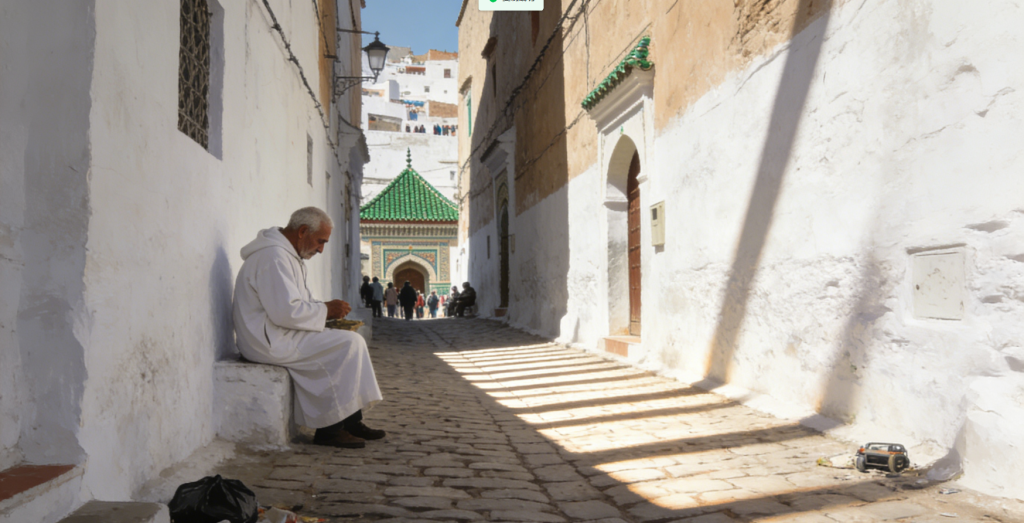
The town’s layout is a three-dimensional map of its sacred priorities. It clings to two primary hills, with the holy tomb complex acting as the gravitational core in the valley between them. Wandering the serpentine, donkey-wide alleys is a lesson in verticality and purpose.
The focal point is the Zawiya (mausoleum complex) of Moulay Idriss. For centuries, this site was the exclusive domain of Muslim pilgrims. It’s crucial to understand: non-Muslims are not permitted to enter the tomb chamber itself. However, the complex’s exterior and the encompassing squares are where you witness devotion in motion. The architecture is a living archive—the green-tiled roofs signify his Sharifian lineage, while the intricate woodwork and zellij (mosaic tilework) speak to centuries of royal patronage and reverence.
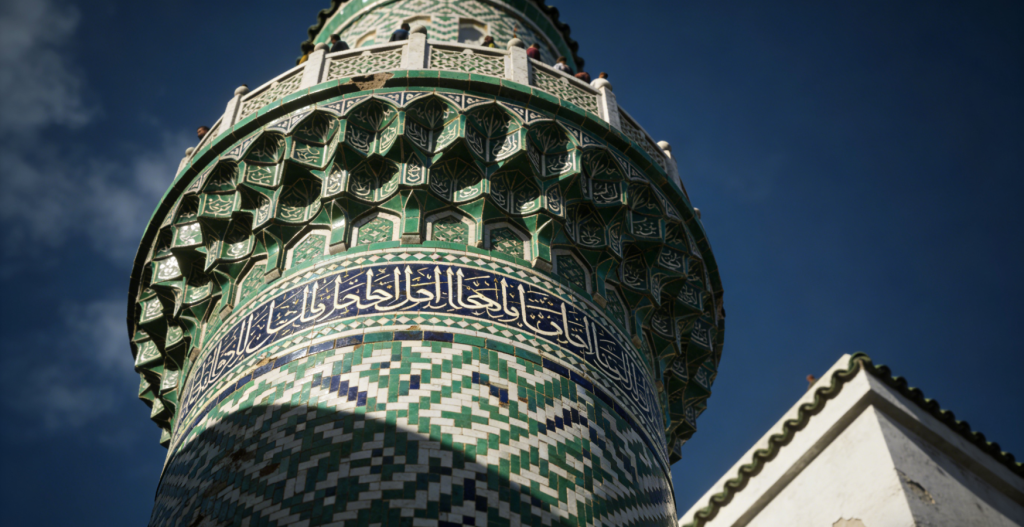
A short, steep walk uphill leads to another architectural marvel: the Sentissi Mosque. Its claim to fame is its unique cylindrical minaret, a stark contrast to the square towers found elsewhere in Morocco. Clad in mesmerizing green and white zellij forming Quranic calligraphy, it is both a beacon and a masterpiece of Maghrebi art. The view from its vicinity, offering a panoramic view of the town’s white cascade against the Zerhoun foothills, is a reward for the climb and a photographer’s dream.
The Ritual Engine: Pilgrimage & The Moussem
Moulay Idriss is not a museum. Its sacred character is kinetic, seasonal, and deeply visceral. The town’s population swells exponentially during the annual Moussem (festival) in August, which coincides with the founder’s birthday. This is when the theoretical importance becomes tangible. Pilgrims from across Morocco arrive with a profound belief: visiting this shrine five times is considered equal in spiritual merit to one pilgrimage (Hajj) to Mecca.
Historical accounts describe even more intense expressions of devotion during these gatherings. In the past, some Sufi brotherhoods performed dramatic dhikr (remembrance) rituals, involving states of spiritual ecstasy. While such extreme displays may be less common today, the Moussem remains a powerful spectacle of faith, with processions, chanting, and a market atmosphere that transforms the tranquil town into a pulsating heart of Moroccan Islam.
Layers of Time: The Roman Counterpoint at Volubilis
No study of Moulay Idriss is complete without acknowledging its dramatic counterpoint: the Roman ruins of Volubilis, a UNESCO World Heritage site located a mere kilometers away. This proximity is not a coincidence but a profound historical lesson.
You can stand on the decumanus of Volubilis, amidst the grand arches and exquisite floor mosaics of a once-prosperous Roman outpost (circa third century CE), and look east to see the white silhouette of Moulay Idriss on its hills. The view connects two distinct world orders: the classical, Mediterranean empire that collapsed and the enduring, faith-based kingdom that rose from its periphery. Volubilis represents a discontinued timeline; Moulay Idriss represents the living continuum that succeeded it. Visiting both on the same day is the ultimate fieldwork in civilizational transition.
The Living Medina: A Code of Conduct for the Observer
Beyond the monuments, the true texture of Moulay Idriss is found in its daily rhythms. Unlike the heavily-touristed medinas of Fez, this town operates for its residents. You’ll find:
Artisans’ workshops tucked into alcoves.
A centuries-old communal bakery where locals still bring their dough.
The weekly souq where the scent of charcoal-grilled meats and spices fills the air.
The sounds of children playing in tight alleyways and the sight of neighbors sharing lengthy greetings.
A Critical Note on Access and Etiquette:
Respect is your passport here. Non-Muslim access has only been relatively recent; the town was closed to outsiders until the French Protectorate era and only opened more fully in the latter twentieth century. Dress conservatively. Always ask explicit permission before photographing people. The best approach is often to hire a reputable local guide from Fez or Meknes; they can navigate the cultural nuances, provide context, and facilitate respectful interactions.
Logistical Intelligence
Base & Transit: Most visitors day-trip from Fez (approx. hours) or Meknes (approx. mins). Private taxis or organized tours that combine Moulay Idriss with Volubilis and Meknes are the most efficient options. There is no direct public transport.
Temporal Strategy: Aim for a weekday visit to avoid the larger crowds that can arrive on weekends with regional visitors. Allow to hours to explore the town’s core alleys and vistas.
The Enthusiast’s Itinerary: A perfect deep-dive day: Start at Volubilis in the cool morning for Roman history. Proceed to Moulay Idriss for midday, exploring the medina and witnessing the rhythm of life. Conclude with the panoramic view from the Sentissi Mosque area as the afternoon light gilds the white town.
Epilogue: The Unbroken Thread
Moulay Idriss endures because it represents an unbroken thread. It is the literal and figurative tomb of the founder, the wellspring of political legitimacy for every Moroccan dynasty that followed (who all trace their support back to the Idrisid paradigm), and a living center of popular Sufi-inspired devotion. It is where the story of Morocco as a cohesive, independent entity began. To walk its streets is not to see a quaint village, but to stand at the very geological stratum where Moroccan identity was formed. For the serious student of history and culture, that is the only reason you need to go.






Discuss