
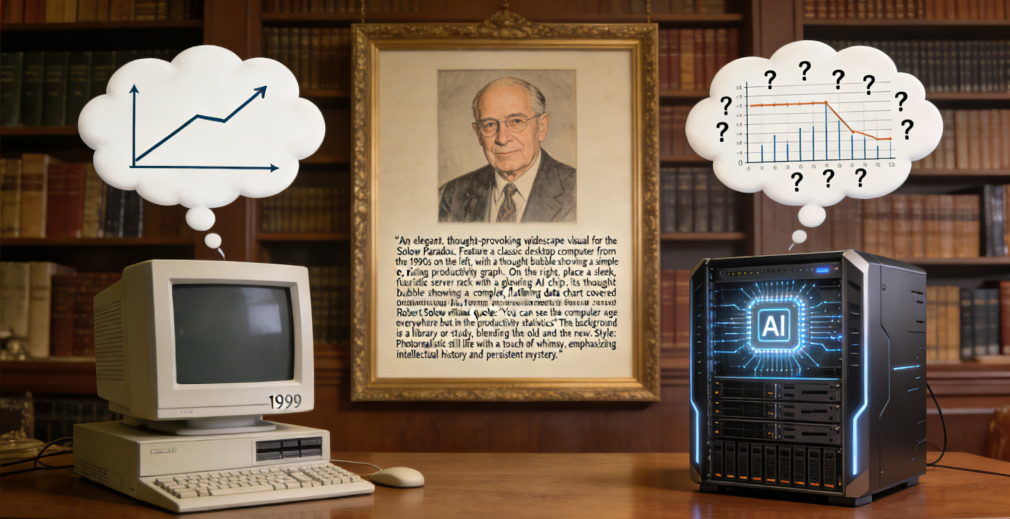
The narrative is compelling, ubiquitous, and backed by astronomical financial commitments: we are living through an artificial intelligence revolution, a technological leap poised to redefine the boundaries of human capability. Venture capital floods into AI startups at a fever pitch; corporate earnings calls are saturated with promises of AI-driven efficiency; and a pervasive cultural anxiety swirls around the technology’s disruptive potential. Yet, when we turn to the most fundamental metric of technological impact—broad, economy-wide productivity growth—we are met with a deafening silence. The data remains stubbornly, perplexingly flat. This disconnect between fervent investment and stagnant output is more than a statistical curiosity; it is the central economic puzzle of our time. We are confronted with a modern, intensified “Solow Paradox,” where we see the AI revolution everywhere but in the productivity statistics. Unpacking this paradox requires moving beyond hype to examine the messy realities of measurement, implementation, and the very nature of value in a digital age.

The initial and most forgiving explanation is a profound failure of measurement. Our economic accounting framework, a product of the mid-20th century, is spectacularly ill-equipped to capture the value created by AI. Traditional productivity metrics measure outputs relative to inputs, typically in terms of physical goods or easily quantifiable services. How does one quantify an AI that improves the accuracy of a medical diagnosis, enhances the creativity of a marketing campaign, or reduces operational risk in a supply chain? These are qualitative improvements, risk mitigations, and enhancements to goods and services that often evade capture in gross domestic product. The national accounts are designed to count the number of cars produced, not the incremental safety provided by an AI-powered driver-assistance system. When a law firm uses AI to review documents in hours instead of weeks, the GDP contribution of the legal sector may actually shrink in the short term, even as client value soars. We are trying to audit the cognitive industrial revolution with ledger books designed for the steam-powered one.
Furthermore, the current phase of the AI boom is one of intense, costly investment and integration, not of harvested output. Corporate expenditures on AI are colossal, but they appear in the national accounts as intermediate costs, not as final productive output. The labor and capital being poured into building large language models, retraining workforces, and restructuring business processes represent a diversion of resources. This is the J-curve effect common to all general-purpose technologies: an initial period of high cost and disruptive absorption precedes the era of payoff. The productivity dividends of the personal computer and the internet were not fully realized until decades after their invention, following the complementary investments in business process re-engineering and skills development. We are likely in the costly, messy “installation phase” of AI, where the noise of construction drowns out the signal of gains.
Beyond measurement and timing lies the thorny issue of diffusion and application. The spectacular capabilities of frontier AI models showcased in demonstrations are not synonymous with smooth, value-generating integration into the complex tapestry of the global economy. For every use case that yields dramatic efficiency, there are countless pilot projects that fail, implementations that introduce new errors (hallucinations, biases), and workflows that become more convoluted as humans are forced to act as supervisors and verifiers for unreliable digital agents. The bottleneck is no longer raw computational power, but organizational capital—the ability to reinvent processes, roles, and incentives around the new technology. Widespread productivity growth requires not just a few firms at the frontier mastering AI, but its broad-based adoption and effective use across the small- and medium-enterprise sector, where resources and expertise are limited.
However, the most disquieting hypothesis is that the AI boom is generating profits without generating productivity—or, more precisely, that it is generating a form of productivity whose gains are captured in a manner that does not translate to broad-based economic growth. This is the distribution problem. AI is a potent tool for rent-seeking and value capture. Algorithms optimized for dynamic pricing, targeted advertising, and intellectual property monetization allow firms to extract more revenue from existing economic activity without necessarily expanding the total value pie. A company using AI to perfect price discrimination increases its profit margin, but this represents a transfer of consumer surplus, not an increase in societal output. Similarly, if AI’s primary commercial application is in creating addictive social media feeds or hyper-effective lobbying tools, it may boost corporate valuations while contributing little to meaningful, measured productivity in sectors that raise living standards.
This points to a potential decoupling of private return from social return. The financial markets are rewarding AI prowess based on anticipated future profits and market dominance. These profits can arise from several channels: genuine innovation and cost reduction (true productivity), but also from increased market power, regulatory arbitrage, and the monetization of attention. The stock market cannot distinguish between these sources of profit, but productivity statistics can. If the AI revolution is disproportionately channeled into the latter activities, we will observe soaring corporate profits and valuations alongside stagnant productivity growth—a scenario where technological progress enriches capital owners without lifting the general economic tide.
Thus, the silence in the productivity data is not an illusion, but a message. It tells us that the transformation is uneven, its benefits are narrowly captured, and our economic institutions are struggling to assimilate it. The phantom dividend may yet materialize, but its arrival depends on factors beyond mere technological advancement: the diffusion of complementary skills, the modernization of our economic measurement, and perhaps most critically, the channeling of AI’s potential toward genuine value creation rather than sophisticated rent extraction. The real test of the AI revolution will not be the intelligence of our machines, but the wisdom of our economic and social systems in harnessing it. Until then, the greatest productivity gains may remain where they have always been most elusive: not in the code, but in the ledger.







Discuss