
For centuries, the fundamental rule of the labor market was simple: talent moved to capital. Ambitious individuals congregated in dense urban hubs—financial districts, tech corridors, political capitals—where high-paying jobs were physically anchored. This gravitational pull shaped nations, creating powerful core-periphery dynamics where prosperity, innovation, and tax revenue were intensely concentrated. The pandemic-era experiment in remote work did not merely introduce a new flexibility; it fundamentally shattered this spatial contract. We are now witnessing the early stages of a Great Unmooring, a historic decoupling of high-value work from specific geographic coordinates. This shift is not a temporary accommodation but a permanent re-architecting of the geography of talent, with profound and destabilizing consequences for cities, regions, and the very meaning of economic opportunity.
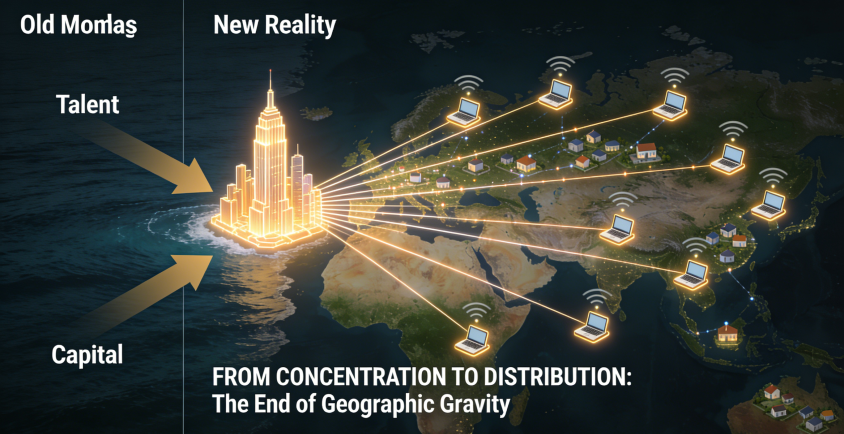
The initial phase was a sudden dispersal. Knowledge workers traded cubicles in San Francisco, London, and Hong Kong for home offices in Boise, Lisbon, or Bali. What began as a necessity has solidified into a structural change. A significant portion of the professional workforce now operates under a hybrid or fully remote model, a shift endorsed by a permanent re-tooling of corporate infrastructure and culture. The result is the denationalization of the labor pool. A firm in New York can now seamlessly employ a software engineer in Warsaw, a designer in São Paulo, and a marketer in Cape Town, all paid according to a complex calculus of local cost, global skill, and corporate policy. This creates a new, fluid global market for talent, but also initiates a quiet crisis for the traditional urban centers whose economies were built on daily agglomeration.
The economic consequences for legacy superstar cities are potentially severe. Their value proposition was predicated on being a nexus. The premium paid for a tiny apartment in Manhattan or San Francisco was, in essence, a fee for access—to networks, to serendipitous encounters, to a dense concentration of employers. Remote work commoditizes and virtualizes much of that access. The immediate threat is to commercial real estate, but the deeper, more systemic risk is to the municipal fiscal model. High urban incomes funded through income and property taxes subsidized extensive public services and infrastructure. As high-earners physically leave or renegotiate their tax residency, cities face a structural budget gap without a corresponding reduction in the cost of maintaining aging transit systems, parks, and public services designed for peak density. The urban core risks a hollowing out, not of people, but of the high-margin economic activity that sustained its ecosystem.
Conversely, this unmooring has ignited a wave of regional rebalancing. Secondary cities, scenic towns, and rural areas with high quality of life are experiencing an influx of remote-enabled professionals. This “zoomtown” phenomenon brings new capital, demand for local services, and a tax base uplift. However, it is not an unalloyed good. It can drive rapid inflation in housing costs, displacing long-time residents and creating new socio-economic tensions. The local economy gains consumers but may not gain the primary employers or the diversified, high-wage job base that ensures long-term resilience. The risk is the creation of picturesque but economically dependent client communities, where the primary export is a Zoom background and the primary import is a salary earned elsewhere.
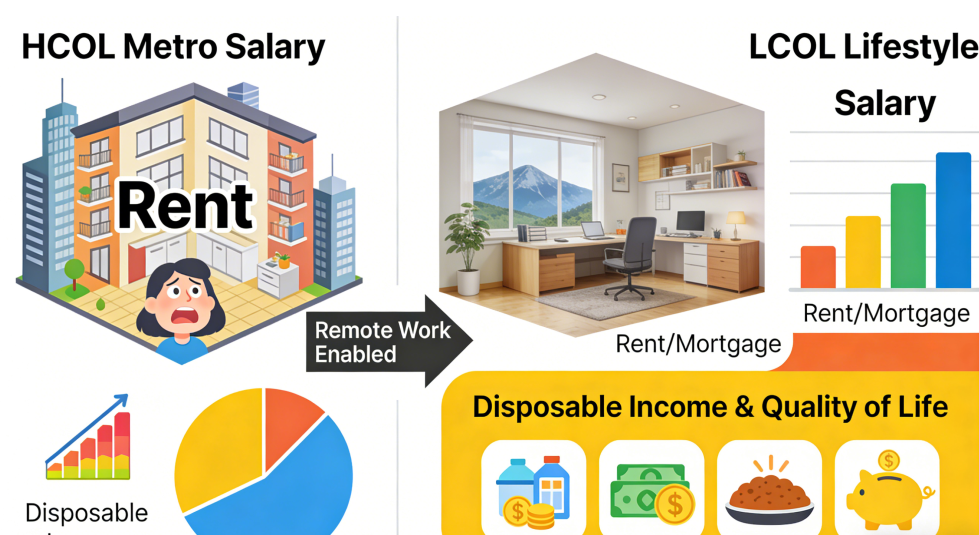
At the individual level, this has given rise to widespread geographic arbitrage—the deliberate relocation to a lower-cost area while retaining a salary pegged to a high-cost labor market. This represents a historic transfer of purchasing power and a redefinition of lifestyle economics. For the arbitrageur, it means vastly improved disposable income and quality of life. For the destination community, it injects outside capital but can distort local economies. For the origin city, it represents a loss of economic vitality. This individual optimization strategy, aggregated across millions, is a powerful new force reshaping real estate markets and consumption patterns globally.
The long-term implications suggest a move from concentrated agglomeration to distributed networks. The economic geography of the 20th century was a map of peaks and valleys—tall, steep mountains of intense activity. The 21st century may resemble a rolling, interconnected landscape of hills. Talent hubs will still exist, but they will be more numerous, smaller, and connected digitally rather than by subway lines. Innovation will occur in networks that are location-aware but not location-dependent. This could lead to a healthier, more resilient distribution of economic activity, reducing regional inequalities and overcrowding.
However, this transition is fraught with governance challenges. Tax authorities must grapple with the nexus problem for remote workers, determining which jurisdiction has the right to tax income earned digitally from another state or country. Local economic development strategies, long focused on attracting corporate headquarters, must pivot to attracting talented individuals by investing in broadband, community, and livability. The competition is no longer between cities to host a company’s office, but to be a desirable node in its distributed talent network.
The Great Unmooring is, ultimately, a democratization of place. It returns agency over geography to the individual worker, breaking the deterministic link between career path and zip code. It promises a rebalancing of spatial inequities. Yet, it also destabilizes the established economic order of cities, creates new winners and losers, and demands a radical rethinking of urban economics and regional policy. The map of talent is being redrawn in real-time, not by planners or politicians, but by the collective choices of millions of individuals logging in from their chosen corner of the world. The future economic landscape will be defined not by where jobs are, but by where people, finally free to choose, decide to live.







Discuss