
Look at your calculator. Its tiny solar panel is a marvel—but it’s also a relic. For fifty years, the solar industry has been running a one-trick pony: silicon, the same material that powers your computer. Silicon panels are amazing, but they’re hitting a hard ceiling. They’re heavy, rigid, expensive to make, and can only ever capture a slice of the sun’s full rainbow of light. What if we could paint a solar panel onto your roof, or make your windows generate power? That future just got a major nudge.
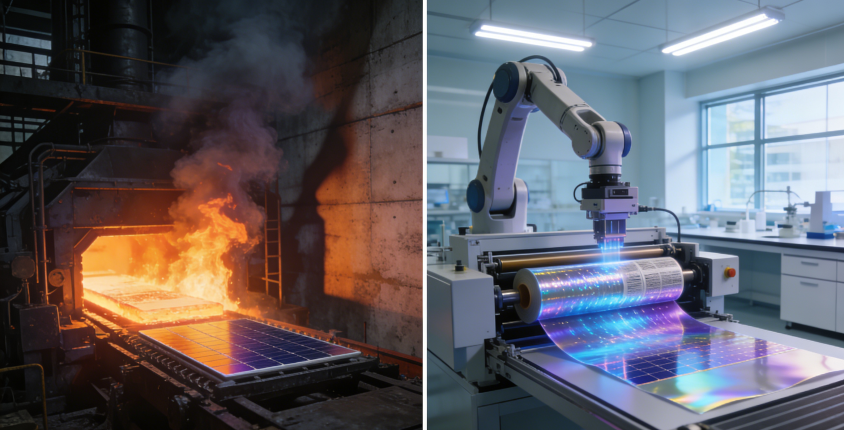
Enter the rockstar of the materials world: perovskite. Don’t let the clunky name fool you. This isn’t a rare mineral; it’s a versatile crystal structure we can cook up in a lab, almost like baking a high-tech cake. For over a decade, it’s been the promising newcomer in solar. Now, in a move that has the entire energy world doing a double-take, researchers have engineered a perovskite-based solar cell that doesn’t just inch forward—it pole-vaults over its silicon ancestors, hitting a record 35% efficiency while slashing potential production costs in half.
So, how does this magic crystal work? Think of sunlight as a bag of mixed candy. Traditional silicon panels are picky eaters; they only grab the red candies (certain light wavelengths) and let the rest go to waste. Perovskite, however, is a hungry teenager. We can tune its atomic recipe to gobble up different parts of the light spectrum. The breakthrough? Scientists have perfected a “tandem” setup: a thin, efficient perovskite layer stacked on top of a standard silicon layer. The perovskite catches the blue and green light, while the silicon underneath mops up the reds and infrared. It’s a dream team, working together to harvest far more energy from the same patch of sunlight.
“The elegance is in its simplicity,” beams a materials scientist whose lab pioneered part of the design. “We’re not just replacing silicon; we’re giving it a super-powered partner. The perovskite film is so thin—a fraction of a human hair—that it’s almost a solar stain. And we can print it, like ink on a page.”
The implications are staggering. First, efficiency. 35% may not sound huge, but in the hyper-competitive world of solar physics, it’s a seismic jump from the commercial 22% silicon standard. It means more power from the same rooftop, the same field, the same desert.
Second, and perhaps more transformative, is cost. Manufacturing silicon requires colossal factories, extreme heat (over 1500°C), and ultra-pure materials. Perovskite films can be made from abundant ingredients in a standard lab, at near-room temperature, using techniques akin to printing a newspaper. This could turn solar panel production from a heavy industry into something closer to a high-tech bakery, distributed worldwide.
Imagine solar films laminated onto the curved roofs of electric cars, constantly topping up their batteries. Picture skyscrapers with power-generating windows, or lightweight solar tarps deployed after natural disasters. The ubiquity of energy generation could redefine our grids.
Of course, there’s a “but.” The traditional knock on perovskite has been its durability—early versions degraded quickly when exposed to moisture and heat. The recent leap forward isn’t just about efficiency; it’s about stability. By tweaking the chemical cocktail and adding protective nano-coatings, the new cells are now surviving rigorous stress-tests for years, a critical hurdle cleared on the path to commercialization.

We are at a tipping point. This isn’t just an incremental upgrade; it’s a paradigm shift from brittle, heavy panels to light, adaptable, and ultra-efficient solar harvesters. The silicon era built the foundation. Now, the perovskite era is poised to paint the future with light. The sun hasn’t gotten any stronger, but our ability to catch its power just became brilliantly, affordably, more potent.







Discuss