
The global semiconductor industry, long the epitome of complex, borderless collaboration, is undergoing a fundamental stress test. As geopolitical tensions redefine notions of technological security, a new and seemingly paradoxical paradigm is emerging: a simultaneous, massive push for regional self-sufficiency in strategic segments, paired with a deepening, inescapable reliance on global cooperation in foundational technologies. This dual-track approach—accelerating sovereign innovation while navigating a web of international interdependencies—is now the central strategic challenge for every major economy and industry leader.
For decades, the semiconductor supply chain was a masterpiece of globalization. Design occurred in the US and Europe, key manufacturing equipment came from the Netherlands and Japan, advanced fabrication concentrated in Taiwan and South Korea, and assembly and testing were prominent in China and Southeast Asia. This model delivered relentless innovation and efficiency. However, its fragility was exposed by pandemic-era disruptions and intensified by export controls designed to preserve technological advantages.
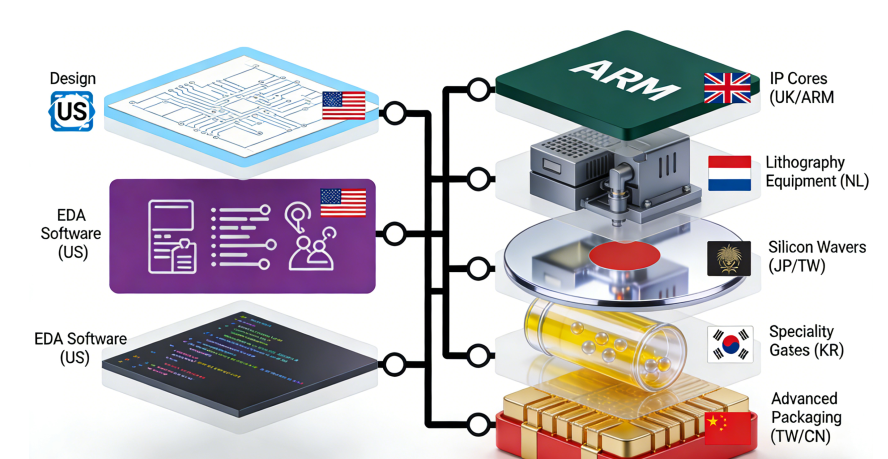
In response, governments are deploying unprecedented industrial policy. The US CHIPS and Science Act, the EU’s Chips Act, and similar initiatives in Japan, India, and South Korea represent a collective investment exceeding $300 billion to onshore segments of the supply chain. The goal is not full autarky—an impossible feat—but strategic redundancy in critical areas like leading-edge logic fabrication and advanced packaging. “The objective is resilience, not isolation,” clarifies a senior trade official involved in transatlantic semiconductor dialogues. “We are building diversified capacity to mitigate systemic risk, but no single region can replicate the entire ecosystem.”
This drive for autonomy is most visible in the race for next-generation nodes. While TSMC and Samsung push the boundaries of physics toward 2nm and beyond, companies like Intel in the US and Rapidus in Japan are making historic investments to re-establish or create sovereign capacity at these leading edges. Simultaneously, China is channeling vast resources into overcoming bottlenecks in equipment and design software, aiming for self-reliance in mature and increasingly advanced nodes.
Yet, this scramble for independence only underscores the industry’s intrinsic interdependence. True autonomy remains a mirage. The most advanced Extreme Ultraviolet (EUV) lithography machines, essential for cutting-edge chips, are produced solely by ASML in the Netherlands, incorporating thousands of specialized components from a global supplier base. Advanced chip design is impossible without software tools from a handful of American firms. “You can build a fab, but you cannot rebuild the global knowledge network overnight,” notes the CEO of a European semiconductor materials firm. “The science itself is collaborative.”
Thus, the industry is fragmenting into strategic spheres of collaboration. Partners within aligned geopolitical blocs are deepening ties. The US, Japan, and the Netherlands coordinate on export controls while fostering joint R&D in areas like quantum computing chips. Meanwhile, global giants like TSMC are adopting a “multi-fab” strategy, building capacity in the US, Japan, and Germany, effectively embedding their expertise within multiple sovereign systems to maintain market access and share risk.
For corporate strategists, this new map demands a delicate balancing act. They must build resilient, often regionalized supply chains to comply with policy and ensure continuity, while still accessing the global innovation frontier. This leads to a “China+1” or “Taiwan+1” manufacturing strategy and increased investment in R&D alliances, such as the IMEC research hub in Belgium or the Silicon Catalyst incubator network.
The ultimate impact on innovation is a subject of intense debate. Some fear that duplication of capacity and “technological decoupling” will waste resources and slow overall progress. Others argue that multiple, regionally focused innovation pipelines, competing and occasionally cross-pollinating, could ultimately accelerate breakthroughs, particularly in specialized areas like automotive or aerospace chips. “We are moving from a single, global innovation highway to a network of specialized high-speed roads,” suggests a venture capitalist focused on semiconductor startups. “The topology is becoming more complex, but the total throughput of ideas may increase.”

In this reconfigured landscape, the winners will be those who master a new form of glocalized operation—leveraging deep local expertise and government partnerships for resilience, while maintaining the global connections and open scientific exchange necessary to stay at the cutting edge. The semiconductor industry, once a quiet enabler of the digital world, now finds itself at the center of a high-stakes renegotiation of how the world innovates and cooperates. Its future will be written not by a single country or company, but in the tense, productive space between the imperative for self-reliance and the reality of mutual dependence.






Discuss