
The grand narrative of blockchain technology is at a crossroads. Beyond the volatile spectacle of speculative cryptocurrencies lies a more profound, if less glamorous, ambition: to become the foundational settlement layer for the world’s real economy. This ambition hinges on the tokenization of real-world assets (RWAs)—the process of converting rights to physical or legal assets into unique digital tokens on a blockchain. From Manhattan skyscrapers and fine art to treasury bills and carbon credits, nearly every illiquid asset class is being scrutinized for its potential to be digitally reborn. This is not merely a technical upgrade; it is an attempt to rewrite the centuries-old economic code governing how we own, value, and trade capital. The central question is whether this innovation can evolve from a niche experiment into the “killer app” that finally delivers on blockchain’s core promises of radical efficiency, transparency, and accessibility, or if it will be eternally hamstrung by the very real-world complexities it seeks to transcend.
The economic promise of RWA tokenization is a powerful answer to endemic market failures. Traditional markets for assets like commercial real estate, private equity, or even high-value collectibles are plagued by profound illiquidity discounts, high intermediation costs, and opaque ownership structures. By digitizing an asset’s economic and ownership rights into programmable tokens, a new financial architecture emerges. Fractionalization allows a $100 million building to be owned by thousands of global investors with minimal entry barriers, theoretically unlocking trillions in trapped capital and distributing wealth-creation opportunities. Atomic settlement, where asset transfer and payment occur simultaneously on the ledger, can reduce transaction times from days to minutes and eliminate a web of custodians, agents, and brokers. Furthermore, programmability enables the automatic execution of complex functions—dividend distributions, compliance checks, or lease agreements—embedded directly into the token’s smart contract, reducing administrative overhead and counterparty risk. In essence, tokenization proposes a shift from a system built on cumbersome reconciliation of separate databases to one of shared, programmable truth.
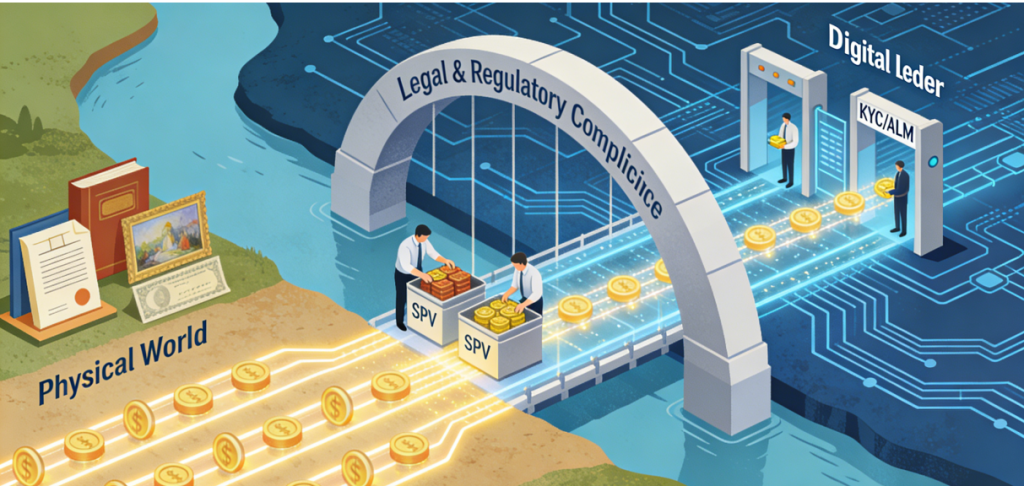
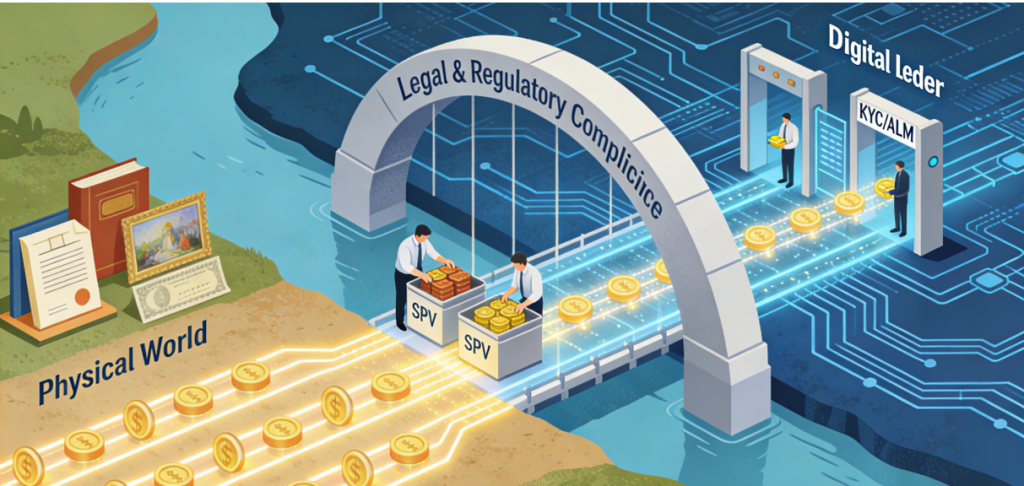
However, the journey from a token on a ledger to legally enforceable ownership of a physical asset traverses a formidable landscape of what innovators euphemistically call “frictions”—primarily legal and regulatory. The most critical challenge is the oracle problem in reverse. While a blockchain can perfectly track token ownership, it cannot, by itself, guarantee that ownership maps to enforceable legal rights in a specific jurisdiction. A token representing a share of a Parisian apartment must ultimately be recognized by the French cadastre (land registry) and courts. This requires a robust “legal wrapper”—often a Special Purpose Vehicle (SPV) or trust that holds the physical asset and issues tokens representing beneficial interest. The integrity of the entire system relies on the flawless alignment of this off-chain legal entity with the on-chain token. Any disconnect renders the token a mere digital collectible, devoid of claim on the underlying asset.
This legal-regulatory maze spawns further complications. Regulatory arbitrage is a tempting but dangerous path. A project might structure itself under a permissive jurisdiction while marketing to investors in strictly regulated markets, inviting swift crackdowns. Securities laws are a particular minefield. Most tokenized RWAs, especially those offering profit participation, will be classified as securities in the US, EU, and elsewhere, demanding full compliance with disclosure, registration, and investor accreditation rules—requirements that starkly contradict the ethos of borderless, permissionless access. Furthermore, the promise of 24/7 global liquidity collides with Know Your Customer (KYC) and Anti-Money Laundering (AML) obligations, forcing platforms to implement “gated” permissioned systems that look increasingly like traditional, albeit more efficient, financial intermediaries.
Despite these headwinds, pilot projects and early adoption are illuminating a path forward, particularly in areas where traditional finance is most inefficient. The tokenization of short-term government debt has emerged as a surprising beachhead. Money market funds like BlackRock’s BUIDL allow stablecoin issuers and crypto-native entities to hold treasury bills on-chain, earning yield with near-instantaneous settlement. This creates a crucial bridge between digital and traditional finance. Similarly, projects in private credit are using blockchain to automate loan origination, servicing, and syndication, offering lenders transparency into a traditionally opaque process. Even in real estate, platforms are demonstrating that fractional ownership can revitalize markets for non-performing assets or enable community-based property investment. These use cases succeed by not attempting to bulldoze the existing legal framework, but by building compliant bridges between the old world and the new.
The ultimate trajectory of RWA tokenization will likely be determined by its ability to forge a workable synthesis, not inspire a revolution. The vision of a fully decentralized, autonomous market for every physical asset is a fantasy that ignores the necessity of legal recourse and systemic stability. The viable future is one of hybridization. We will see permissioned, institutionally-governed blockchains acting as vastly improved settlement and record-keeping layers for existing financial products. Central Bank Digital Currencies (CBDCs) could become the preferred settlement token for these markets. The true “killer app” may not be disintermediation, but super-intermediation—a dramatic increase in efficiency, auditability, and accessibility within a regulated, institutional perimeter.
Therefore, the question shifts. Tokenization may not be the killer app for the libertarian ideal of blockchain, but it is rapidly proving to be the killer app for its practical utility. Its success will be measured not by the demolition of the financial system, but by its silent integration into the plumbing of global finance, making capital allocation marginally faster, cheaper, and more inclusive. In this less radical but more realistic guise, tokenizing everything could slowly, inexorably, rewire the world’s asset machine from the inside out.







Discuss