
In the traditional playbook of economics, competition thrived on the clarity of choice. A consumer would compare Product A against Product B, weighing features, quality, and price before making a discrete purchase. This model, however, is being systematically dismantled in the digital age, not by inferior products or predatory pricing, but by a strategy of overwhelming convenience: the Bundling Revolution. From the streaming wars to the rise of the “Everything App,” companies are no longer selling products; they are selling integrated ecosystems. By bundling disparate services into a single, seamless package, they are achieving a form of market dominance that is far more subtle and resilient than old-fashioned monopolies. This revolution is not about making things cheaper in isolation, but about making leaving inconceivably costly, fundamentally reshaping the dynamics of competition and consumer sovereignty.
The economics of digital bundling are uniquely potent because the marginal cost of adding another service—another movie to a library, another feature to an app—is effectively zero. This allows platforms to engage in what economists call mixed bundling, offering a vast array of services for a single monthly fee that is less than the sum of its parts. For the consumer, the value proposition is irresistible: maximum utility for minimal cognitive and financial transaction cost. Why subscribe to six different streaming services, manage six bills, and remember six passwords when one “Super Bundle” from a tech giant offers a “good enough” selection of everything? The immediate benefit is real convenience. The long-term consequence, however, is the erosion of standalone competition. A brilliant, niche documentary platform cannot compete on price or convenience with a bundled behemoth that offers documentaries as a loss-leading fraction of its entertainment package. The bundle doesn’t have to be the best in every category; it merely needs to be sufficiently comprehensive to make seeking a “best-in-class” alternative feel like a hassle.
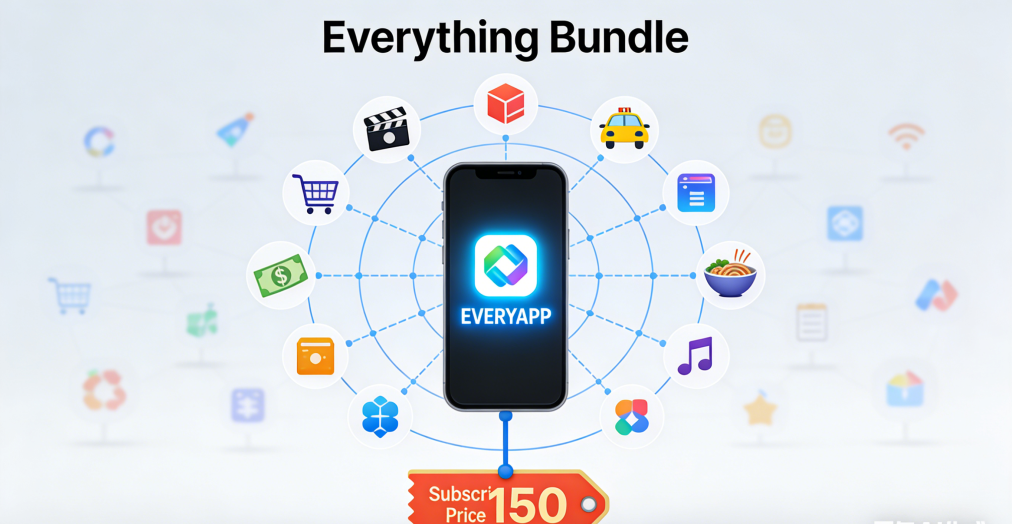
This leads to the bundle’s most powerful mechanism: the construction of a “convenience prison.” The cost of switching from a bundled ecosystem is not primarily financial; it is a cognitive and logistical tax. Exiting means fragmenting a unified experience back into a dozen individual services, re-entering payment details, re-establishing preferences, and losing a unified history or recommendation engine. The bundle becomes the default infrastructure of daily life. As Nobel laureate Ronald Coase might have observed, the bundle dramatically lowers the “transaction costs” for the consumer within the walled garden, while simultaneously raising the “transaction costs” of dealing with any outside party to prohibitive levels. Competitors are thus faced not with competing on a feature, but with displacing an entire, deeply embedded lifestyle architecture.
In this environment, competition shifts from a battle over products to a battle over gateway control. The most valuable real estate is no longer the best movie or the most efficient payment tool, but the primary interface—the home screen, the messaging inbox, the operating system—through which the user accesses multiple services. Once a company controls this gateway through a dominant app or device, it can preferentially bundle its own services, steering users toward its offerings and making discovery of independent alternatives algorithmically difficult. This is the “super app” model perfected in Asia and now coveted globally: a single portal for messaging, payments, transportation, shopping, and entertainment. Here, competition between individual service providers is subdued; instead, competition occurs at the meta-level between a few rival super-bundles, each seeking to become the operating system for a user’s entire digital—and increasingly, physical—life.

The implications for market health and innovation are profound. First, bundling drives market concentration not through superior efficiency in a single line of business, but through cross-subsidization and leveraging dominance in one area to capture another. This can stifle the “creative destruction” that economist Joseph Schumpeter saw as essential to capitalism, as nascent innovators are acquired or suffocated long before they can challenge the bundle’s core value proposition. Second, it changes the nature of consumer choice. Choice is not eliminated, but it is transformed from an active, evaluative decision between competitors into a passive, inertial acceptance of a curated suite. The consumer votes with their monthly subscription, not for the best movie studio or bank, but for the most convenient aggregator.
Finally, this model presents a quagmire for regulation. Antitrust law, built for an era of steel and oil, struggles to confront power derived from convenience and data aggregation rather than price gouging or exclusive dealing. A bundle can be pro-consumer in the short term (lower prices, more features) while being anti-competitive in the long term by foreclosing future markets. The harm is not today’s price, but tomorrow’s absence of choice and innovation.
The Bundling Revolution reveals a new economic truth: in the attention economy, low friction is the ultimate competitive moat. Companies are no longer just selling services; they are selling the absence of hassle. In doing so, they are building commercial empires that are extraordinarily difficult to challenge, not because their walls are high, but because the drawbridge is so convenient to lower. The future of competition may not be a marketplace of the best products, but a landscape of a few, all-encompassing ecosystems. In this world, the most precious commodity is not a specific good, but the freedom and simplicity to choose one—a freedom that the very logic of the bundle is designed to gently, and irresistibly, take away.







Discuss