
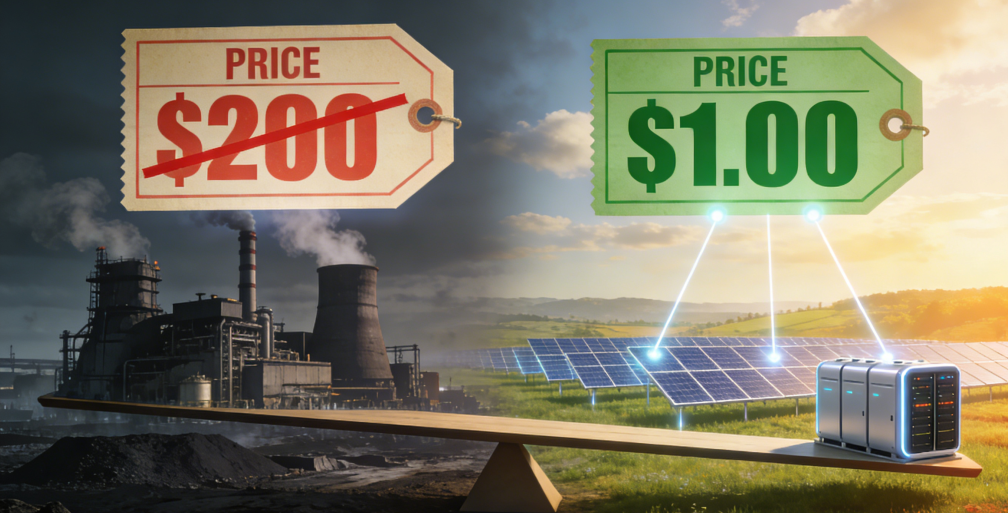
For years, the central economic argument against a rapid energy transition hinged on a single, stubborn metric: the Green Premium. This was the additional cost of choosing a clean technology over its entrenched, fossil-fueled counterpart. It was the justification for subsidies, the fuel for political debate, and the barrier that supposedly protected the old world. Then, almost silently, the premium began to vanish. Not through sheer political will, but through the relentless, exponential logic of technology, manufacturing, and finance. Today, across the most critical fronts of the energy battle—power generation, storage, and mobility—the Green Premium has not only disappeared; it has inverted. We are now living in the age of the Green Discount, a fundamental economic shift that is detaching the clean energy transition from political cycles and anchoring it in the immutable laws of competitive markets.
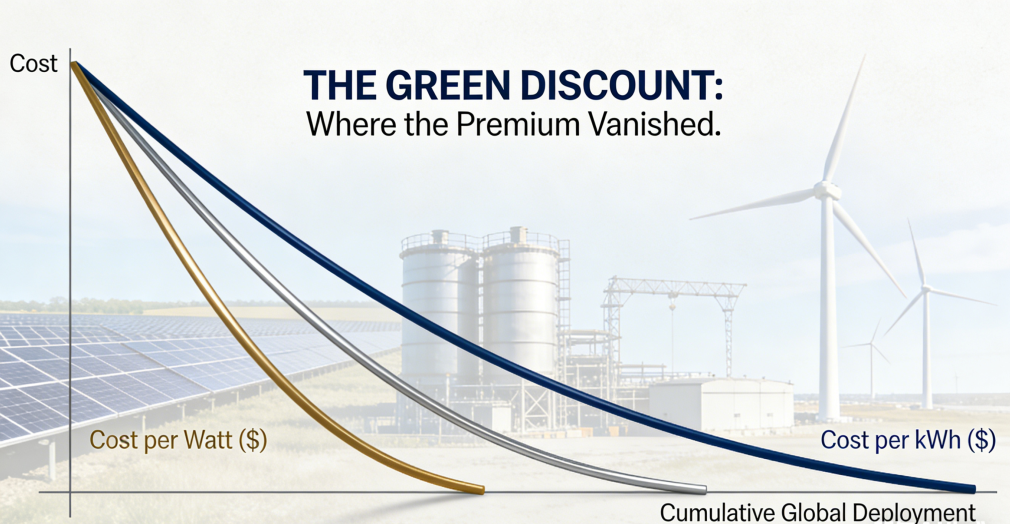
The most spectacular and consequential vanishing act has occurred in electricity generation. The levelized cost of electricity (LCOE) from utility-scale solar photovoltaics has plummeted by over 90% in the past decade, making it the cheapest source of new electricity in history across most of the planet. Wind power has followed a similar, if slightly less steep, trajectory. This is no longer a forecast or a hopeful projection; it is the lived reality of power purchase agreements from Texas to India. The “premium” for clean power is now a discount against new natural gas or coal plants. This reversal is so profound that the conversation has shifted from justifying renewables to managing their grid integration. As one utility CEO in the American Southwest noted, “Our procurement decisions are now driven by financial and engineering models, not environmental ones. The cheapest and most reliable portfolio is the one with the most sun and wind.”
This revolution in generation is being cemented by a parallel breakthrough in its natural partner: energy storage. For years, the intermittency of renewables was their Achilles’ heel, with battery storage carrying a prohibitive green premium. That era is over. The cost of lithium-ion battery packs has fallen nearly 90% since 2010, driven by advancements in chemistry, manufacturing scale (most notably from China), and vertical integration in the supply chain. When combined with cheap solar, “solar-plus-storage” projects are now outcompeting fossil-fuel “peaker” plants—the expensive, rarely-used facilities fired up during times of highest demand—on cost alone. The business case is no longer about carbon; it’s about providing more predictable, dispatchable, and ultimately cheaper power.
The third pillar of the transition, road transport, has reached its own historic inflection point. The analysis has moved beyond the sticker price of the vehicle to the total cost of ownership (TCO). When fuel, maintenance, and depreciation are accounted for, electric vehicles are already cheaper to own and operate than internal combustion engine vehicles in major markets like China, Europe, and parts of the U.S., even without subsidies. Battery costs, the single largest component of an EV’s price, continue to fall, promising upfront price parity within the next few years. The green premium for mobility is evaporating in the rearview mirror, with automotive executives now treating electrification as a non-negotiable pillar of future profitability, not a regulatory compliance cost.
Several powerful, self-reinforcing engines are driving this cost collapse. Wright’s Law—the observation that costs fall by a predictable percentage each time cumulative production doubles—has proven spectacularly accurate for solar panels, wind turbines, and batteries. As global deployment has skyrocketed, costs have followed the curve downward. Simultaneously, financial engineering has slashed the cost of capital for proven technologies. Banks now understand solar and wind assets as low-risk investments with predictable, long-term cash flows, leading to lower interest rates and more favorable terms, which further reduces the LCOE. Furthermore, policy itself has become a cost-reduction tool, not just a subsidy mechanism. Standardized permitting, streamlined grid connection processes, and ambitious public procurement (like corporate renewable energy targets) have reduced “soft costs” and provided the demand certainty that triggers mass manufacturing investment.
The implications of this crossed cost rubicon are seismic. First, it has decoupled the pace of transition from political ambition. Nations with less aggressive climate policies are now deploying wind and solar at record rates because it simply makes economic sense. The energy transition has graduated from being a policy-driven exercise to a market-driven inevitability. Second, it has triggered a fundamental reallocation of capital. Trillions in investment are now flowing not out of altruism, but in pursuit of superior risk-adjusted returns in the new energy economy. Fossil fuel assets are increasingly seen as stranded investment risks, vulnerable to competition from cheaper, cleaner alternatives.
Yet, the vanishing premium is not universal. Hard-to-abate sectors like steel, cement, aviation, and shipping still face a significant green premium for solutions like green hydrogen or sustainable aviation fuel. Closing this gap is the next great frontier, requiring a combination of scaled manufacturing, supportive infrastructure, and likely, intelligent carbon pricing. The focus now is on making the first commercial plants a reality to kickstart their own cost-reduction cycles.
The story is no longer about whether clean energy can compete. It does, and it wins. The story is now about velocity and integration. How fast can grids be modernized to absorb this cheap, abundant power? How quickly can supply chains for critical minerals be scaled responsibly? The economic debate is settled. The green premium was a temporary phenomenon, a feature of technologies in their infancy. Its disappearance marks the true beginning of the energy transition—not as a moral crusade, but as the most profound industrial and economic reorganization of the century, driven by the most powerful force of all: a better, cheaper product.







Discuss