
Forget incremental updates. The electric vehicle landscape of 2026 is set for a tectonic shift, moving beyond the era of simple range wars and into a new paradigm defined by energy autonomy, intelligent motion, and seamless digital integration. The conversation is no longer just about the battery in your car, but about how your car interacts with the grid, the road, and even your home. For the savvy buyer, understanding these four converging “black tech” trends isn’t just academic—it’s the key to making a future-proof investment. Let’s decode what’s coming.
From Energy Consumer to Energy Node: The V2G & Battery Revolution
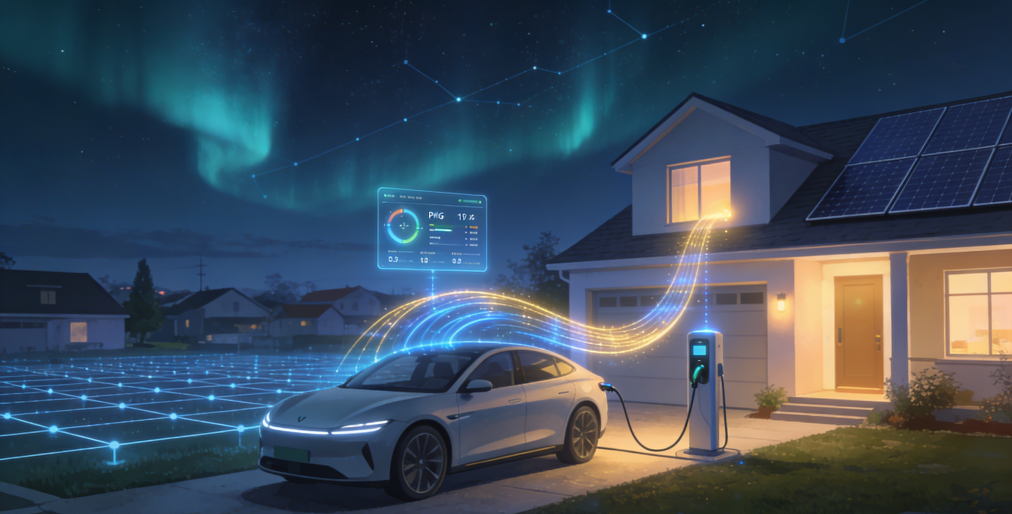
The biggest evolution is redefining the car’s role in the energy ecosystem. The vision of Vehicle-to-Grid (V2G) technology is transitioning from pilot projects to early commercialization. Your EV will no longer just draw power; it will become a mobile storage unit for the grid, charging during off-peak hours (or when solar is abundant) and feeding electricity back during peak demand. The economic incentive is real: analysts suggest a typical EV owner could earn back $2,000-$5,000 annually through such energy arbitrage, turning a depreciating asset into a potential revenue stream.
This is enabled by a dual revolution in battery tech and charging:
Solid-State on the Horizon: 2026 marks a critical inflection point. While mass-market, affordable solid-state batteries are still a few years out, we will see semi-solid-state batteries achieving meaningful production volumes. These offer energy densities of 300-350 Wh/kg, enabling real-world ranges of 800-1000 km, and significantly improved safety. Full-solid-state batteries will debut in high-end demonstration models, promising even greater leaps.
The Sodium-Ion Entry: Alongside lithium, sodium-ion batteries will begin mass deployment, particularly in lower-range models and energy storage. While offering slightly lower energy density, they excel in cold-weather performance, safety, and, crucially, reduce dependence on lithium resources, promising greater cost stability.
Hyper-Charging Becomes Standard: The 800V high-voltage architecture will trickle down from luxury to become mainstream in the $20,000-$30,000 price bracket. Coupled with 4C-6C ultra-fast charging batteries, the experience of “charging for 10 minutes to gain 400 km of range” will become a common expectation, finally closing the refueling gap with gasoline cars.
Your Takeaway: Prioritize models with bidirectional charging capability and a robust V2G partnership program with your local utility. When comparing batteries, look for semi-solid-state promises for maximum range, but consider sodium-ion if you live in a cold climate and prioritize total cost of ownership.
The Intelligent Chassis: From Mechanical Parts to a Unified “Motion Brain”
Beneath the sleek exterior, the very skeleton of the car is getting a digital nervous system. The era of the integrated, domain-controlled “smart chassis” is dawning. This isn’t just about individual components like air suspension; it’s about the deep fusion of steering, braking, damping, and powertrain into one harmoniously controlled system.
X+Y+Z Axis Fusion: Advanced chassis will coordinate longitudinal (acceleration/braking), lateral (steering), and vertical (suspension) movements in real-time. This means the car can subtly adjust its posture before you even feel a bump or enter a curve, delivering unprecedented stability and comfort.
The AI Co-Pilot for Motion: This integrated chassis is the perfect partner for advanced driving systems. When an AI pilot detects a pothole 200 meters ahead, it can instruct the suspension to prepare in milliseconds. In slippery conditions, braking, torque vectoring, and stability control can work as a single, ultra-precise unit to maintain control.
Your Takeaway: Look beyond horsepower and torque. Inquire about the vehicle’s chassis domain controller and its level of integration. Marketing terms like “AI Chassis” or “XYZ Fusion Control” indicate the car treats driving as a holistic, software-managed experience, not just a collection of hardware parts.
The Onboard AI Leap: From Assistants to Co-Drivers
In-cabin AI will evolve from a voice-activated remote control to a contextual partner. Powered by more powerful, cost-effective Qualcomm 8295-level chips, the digital cockpit will understand complex, multi-intent commands and maintain conversational context. The real game-changer, however, is in the driver’s seat.
The Arrival of “L2+”: 2026 will be the year L2+ advanced driver-assist systems become a standard feature in the $20,000-$30,000 range. Functions like automated lane changes, highway interchange navigation, and even basic urban point-to-point guidance will be commonplace.
The L3 Threshold and the Robotaxi Factor: While full consumer L3 (“eyes-off”) adoption will be gradual, the technology will mature rapidly, fueled by the parallel universe of Robotaxis. Companies like Tesla are pushing towards unsupervised, scaled Robotaxi operations. This race accelerates the development of the robust, redundant sensor suites (lidar, radar, cameras) and fail-operational systems that will eventually trickle down to consumer cars.
Your Takeaway: Evaluate a car’s AI on two fronts. For the cabin, test the natural language processing with complex, multi-step requests. For driving, prioritize cars with a clear, over-the-air upgrade path to higher autonomy levels and hardware (like a solid sensor suite) that won’t become obsolete in two years.
The Business Model Pivot: From Ownership to Integrated Tech Subscriptions
The relationship with your car is becoming more fluid. The industry is moving towards technology-centric, service-oriented models.
The “Feature-on-Demand” Economy: Expect more manufacturers to offer high-margin features via subscription. This could range from monthly fees for advanced driver-assist software to performance boosts or even personalized chassis tuning packages (e.g., a sportier suspension profile for weekend drives).
Battery as a Flexible Asset: The concept of battery leasing or “charging as a service” will evolve. Imagine subscribing to an “unlimited ultra-fast charging” plan bundled with your car payment, or having the flexibility to upgrade your battery pack for a longer-range model in a few years without buying a new car.
Your Takeaway: Scrutinize the long-term cost of ownership. A lower sticker price might be offset by mandatory subscriptions for essential features. Favor brands with transparent, customer-friendly subscription policies that add genuine value rather than locking away standard functions behind a paywall.

The 2026 Buyer’s Strategic Edge
Your next EV is more than transport; it’s a connected energy asset, a software-defined experience, and a rolling data center. In 2026, the winning choice won’t be the car with the highest peak power, but the one built on the most adaptive and open architecture. Prioritize bidirectional charging readiness, a domain-based electronic/software architecture that promises continuous updates, and a manufacturer with a credible, long-term roadmap for both battery tech and autonomous driving. The cars that will age gracefully are those designed not just for today’s roads, but for tomorrow’s connected, intelligent, and dynamic world.







Discuss