
We are witnessing a quiet but profound inversion in the architecture of technology innovation. The open-source movement, having conquered the world of software, is now cascading downward into the very bedrock of computing: hardware design and semiconductor technology. This convergence with the physical limits of Moore’s Law is not merely creating new tools; it is fundamentally rewiring the economics, velocity, and geography of how advanced technology is created. The old, linear model of proprietary, vertically integrated R&D is giving way to a dynamic, collaborative ecosystem—a shift as consequential as the rise of Linux, but now playing out in the realm of atoms and electrons.
For decades, open source thrived in the abstract, infinitely replicable world of code. Its virtues—collaborative development, transparency, rapid iteration—defined the cloud, mobile, and internet eras. Meanwhile, the semiconductor industry below operated on a starkly different principle: extreme capital intensity and deep secrecy. Chip design was guarded by fortress-like IP portfolios, and fabrication was the domain of a few global giants. The end of “easy” Moore’s Law scaling, where each new node delivered automatic performance gains, has shattered this dichotomy. As pure transistor shrinkage becomes prohibitively expensive and difficult, the industry’s focus has pivoted to specialization and architectural innovation. This is precisely where the open-source model finds its most potent new application.
The clearest manifestation is the rise of open Instruction Set Architectures (ISAs), most notably RISC-V. Unlike proprietary ISAs from Arm or x86, RISC-V is a free, open standard. It acts as a foundational blueprint upon which anyone can build a processor, customized for a specific task—be it an efficient microcontroller for a smart sensor or a specialized accelerator for artificial intelligence. This has democratized chip design, enabling startups, academia, and even large corporations to innovate without the burden of architectural licensing fees or restrictions. “RISC-V is not just a new processor core; it is the hardware equivalent of the Linux kernel,” explains the head of a semiconductor consortium. “It provides a common, open foundation upon which an entire ecosystem of specialized silicon can be built.”
This open hardware ecosystem extends beyond ISAs. Projects like Google’s OpenTitan (for secure chip roots of trust) and OpenROAD (an automated toolchain for chip design) are systematically lowering the barriers to entry. The result is an explosion of Domain-Specific Architecture (DSA). Companies are no longer waiting for a general-purpose CPU to get faster. Instead, they are designing their own chips—AI training units, networking processors, bioinformatics accelerators—tailored to their exact workload, often leveraging open-source components in their design flow.
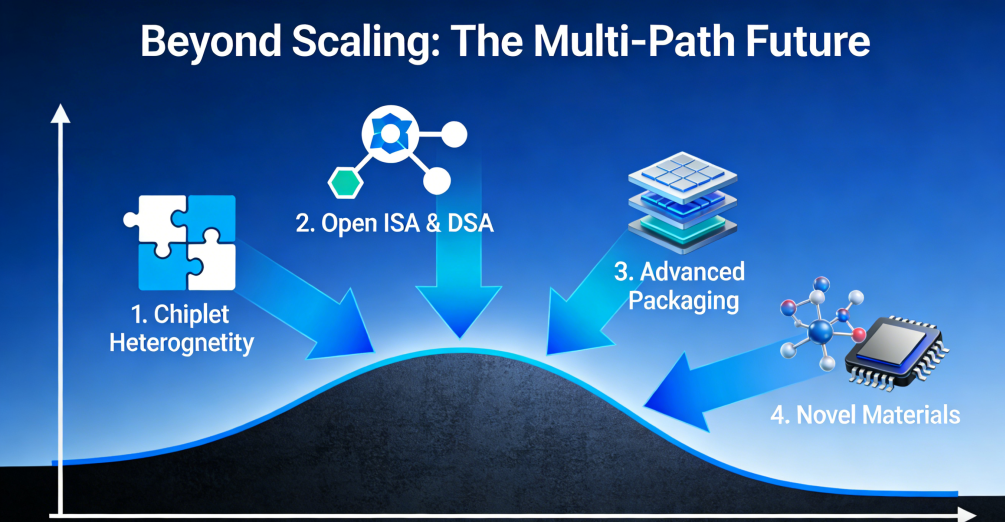
This shift directly addresses the “Post-Moore” challenge through a strategy of diversified innovation. The industry is advancing on multiple, parallel fronts simultaneously:
- Advanced Packaging & “Chiplets”: Instead of building a single, monolithic die, designers are assembling smaller, modular “chiplets”—each potentially optimized in a different process node or even from a different vendor—into a single package using technologies like silicon interposers. Open standards for chiplet interfaces (e.g., UCIe) are crucial here, allowing a mix-and-match ecosystem to flourish, much like open APIs enabled software modularity.
- Novel Materials & Transistors: While traditional silicon scaling continues at a slower pace, research into new materials (like gallium nitride for power chips or 2D materials like graphene) and transistor architectures (Gate-All-Around, CFET) is intensifying. Open-access university fab facilities and shared research platforms, often supported by government initiatives, are accelerating basic research in these areas.
- Co-Design & New Computational Paradigms: The line between hardware and software is blurring. The open-source model facilitates the tight co-design of algorithms, compilers, and silicon. Furthermore, exploration into fundamentally different paradigms—photonics for data movement, neuromorphic computing for brain-like processing, and quantum computing for specific problems—is being propelled by open research collaborations and shared simulation frameworks.
The commercial and geopolitical implications are vast. The open-source hardware model disperses strategic leverage. It enables nations and companies to cultivate sovereign design capabilities without being locked into a single proprietary architectural provider. It lowers the cost of innovation, allowing capital to flow into differentiated specialization rather than reinventing foundational standards.
However, this new world demands new forms of collaboration. Open-source software thrives on GitHub commits and cloud deployments. Open-source hardware requires coordination across fabless design houses, EDA tool vendors, foundries, and package assembly—a vastly more complex supply chain. Successful ecosystems are being built around shared physical design platforms and verified manufacturing “shuttles” where multiple organizations share the mask cost of a prototype production run.
We have moved from an era where computing power was a monolithic, proprietary resource to one where it is a collaboratively designed, modular, and highly specialized utility. The open-source cascade is dismantling the final wall between the agile world of software and the physical world of silicon. The future of technology will not be defined solely by who owns the most advanced fab, but increasingly by who can best orchestrate innovation within this vibrant, open, and deeply interconnected hardware-software ecosystem. The post-Moore era is not an age of limitation, but an age of proliferating possibilities, unlocked by the principles of shared development.







Discuss