
For generations, the university degree has functioned as the gold-plated circuit breaker in the labor market—a trusted, standardized device designed to manage the overwhelming current of information between employers and job seekers. Its economic value was derived not merely from the knowledge it purportedly certified, but from its efficiency as a signal. In a world of asymmetric information, the degree served as a costly-to-obtain credential that reliably sorted candidates by attributes like diligence, cognitive ability, and conformity to institutional norms. This system, while imperfect, provided a common currency for human capital.
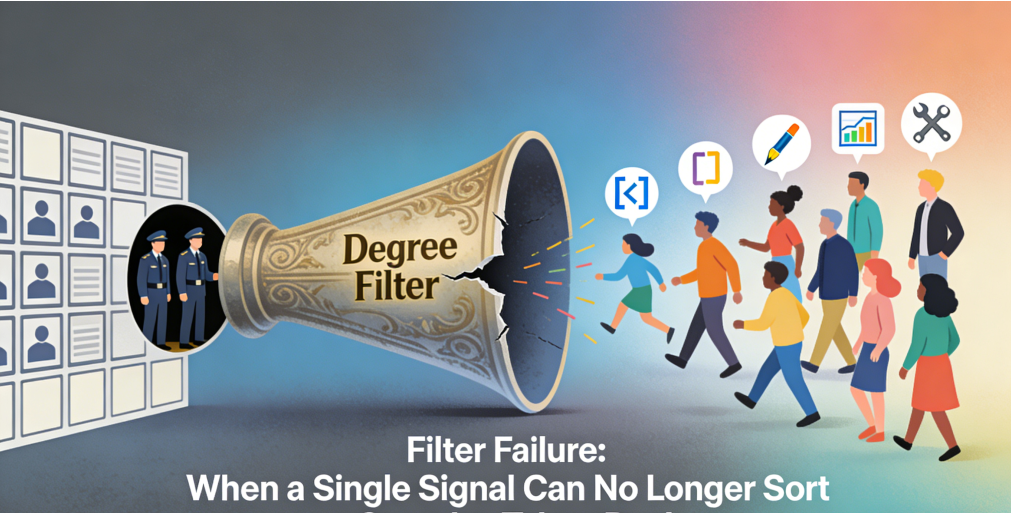
That currency is now undergoing a profound devaluation, not through collapse but through competitive disruption. We are in the midst of The Great Unbundling, where the monolithic signal of a four-year degree is being disaggregated into its component parts by the forces of technological change, shifting corporate strategy, and a re-evaluation of cost versus return. The question is no longer whether degrees are “worth it” in the abstract, but which specific elements of their signaling power remain viable in a labor market increasingly optimized for demonstrable, immediate competency. This represents a fundamental recalibration of how skill is defined, verified, and valued.
The Erosion of the Monopoly Signal
The degree’s power relied on scarcity and consensus. Both are waning. The massive expansion of higher education over the last half-century has produced a glut of credentials, diluting their exclusivity and thus their signaling potency. A bachelor’s degree is now a common baseline, not a differentiator. Concurrently, the escalating financial and temporal cost of obtaining one has triggered a rigorous scrutiny of its return on investment. When student debt burgeons into a systemic economic burden, the assumed premium attached to the credential faces intense market skepticism.
More critically, the core premise of the signal—that it correlates strongly with workplace productivity—has come under fire. Employers across sectors, but most vocally in technology, voice a persistent complaint: the academic curriculum is misaligned with the velocity of practical skill demand. The “shelf-life” of technical knowledge shrinks relentlessly, while the institutional processes of academia change slowly. This has created a credential-to-competency gap, where the signal (the degree) increasingly fails to predict the desired outcome (job-ready skill). The resulting phenomena of underemployment and the rise of degree requirements for jobs that historically did not need them are not mere labor market frictions; they are symptoms of a signaling system in decay.
The Rise of the Skill-Based Paradigm
In response, a new signaling paradigm, pioneered by the tech industry but now spreading rapidly, has emerged: skill-based hiring. This model represents a direct market correction. It seeks to bypass the noisy, costly degree signal in favor of more direct, verifiable measures of capability. Companies like Google, IBM, and Ernst & Young have systematically removed degree requirements from thousands of roles, substituting them with mechanisms designed to assess actual performance:
- Portfolios and Practical Assessments: A GitHub repository, a design sprint outcome, or a case study analysis provides a more granular and truthful signal of applied skill than a transcript.
- Role-Specific Certification: Industry-recognized certifications (e.g., in cloud architecture, specific coding frameworks, or digital marketing analytics) offer a targeted, current, and often cheaper validation of a discrete skill set.
- Structured Behavioral Evaluation: Techniques like work-sample testing assess problem-solving and collaboration in contexts mirroring real job tasks.
This shift is economically rational. It reduces hiring risk by focusing on proximate evidence of productivity rather than distant, proxy credentials. It also expands the talent pool, accessing candidates whose skills were acquired through non-traditional pathways—bootcamps, self-directed learning, military service, or freelance work. The market is effectively creating a more efficient information system, where signals are more tightly coupled to the specific needs of the firm.
The Re-Bundling: Ecosystems of Trust and the University’s Pivot
The narrative is not, however, a simple story of displacement. It is one of re-bundling. The ultimate endpoint is not a world without credentials, but one with a more diverse, modular, and dynamic credentialing ecosystem. The university’s monopoly is broken, but its role is evolving.
Forward-thinking institutions are responding not by defending the traditional degree but by unbundling and repackaging their own offerings. This manifests in the rise of:
- Micro-credentials and Digital Badges: Certifying specific skill achievements that can be stacked toward larger qualifications.
- Corporate-Academic Partnerships: Co-designed curricula that embed industry tools and projects directly into academic credit.
- Emphasis on “Durable” Skills: A renewed focus on teaching critical thinking, communication, and complex problem-solving—the meta-skills that remain valuable across technological shifts.
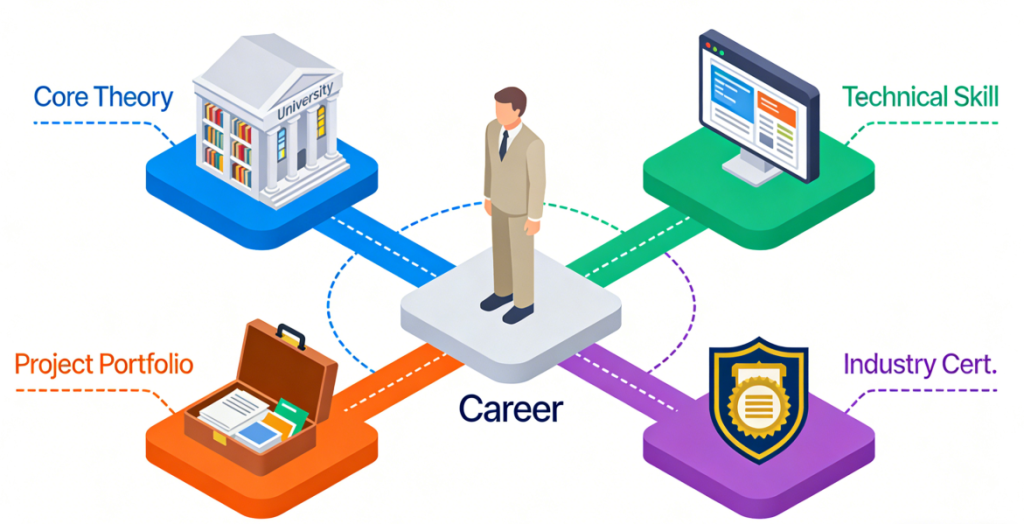
In this new landscape, trust is distributed across a network. A candidate might present a hybrid credential: a foundational knowledge base from a university, a technical skill validated by a professional certificate, and a project history verified on a platform like LinkedIn. Employers will increasingly rely on this portfolio of signals, weighing them according to their specific needs. The university degree becomes one node in this network, valued perhaps more for its cultivation of foundational capacities and its network effects than for its job-specific training.
Implications and the Road Ahead
The economic and social implications of this unbundling are vast:
- Wage Structures and Inequality: The wage premium will likely continue to decouple from the mere possession of a degree and re-attach to the possession of scarcer, high-demand skills. This could democratize opportunity by valuing skill regardless of origin, but it also risks new forms of inequality based on access to continuous, just-in-time upskilling.
- The Policy Imperative: Public policy must accelerate to support this transition. This includes funding for alternative training pathways, creating transparent skill taxonomies to help workers and employers navigate the new ecosystem, and modernizing accreditation to recognize competency-based learning.
- The Lifelong Learning Imperative: For individuals, the implication is clear. The model of “learn once, work for decades” is obsolete. Economic resilience will depend on the capacity for continuous skill acquisition and the savvy curation of a personal credential portfolio.
The credential crunch is, therefore, a sign of a market working—albeit with disruptive force. It is dismantling an outdated information mechanism and constructing a more nuanced, responsive, and potentially equitable system in its place. The value of deep, structured education endures, but its form and its relationship to employment are being permanently rewritten. The future belongs not to the degree-holder alone, nor to the solely self-taught, but to those who can effectively navigate and assemble the building blocks of competence in a world where learning is never finished.






Discuss