
In the sprawling digital bazaar where content is infinite and instantly accessible, a stark inversion of classical economics has taken hold. The scarce resource is no longer the good being produced, but the human capacity to perceive it. Attention, that finite and flickering cognitive commodity, has emerged as the fundamental currency of the 21st century. Its allocation dictates the fortunes of platforms, reshapes creative industries, and underpins novel advertising paradigms. This article moves beyond metaphor to construct an economic model of attention as a tradable good with unique properties of scarcity, perishability, and asymmetric value. By examining its extraction, pricing, and market structures, we provide a critical framework for understanding the core operational logic—and the profound social consequences—of the digital economy.
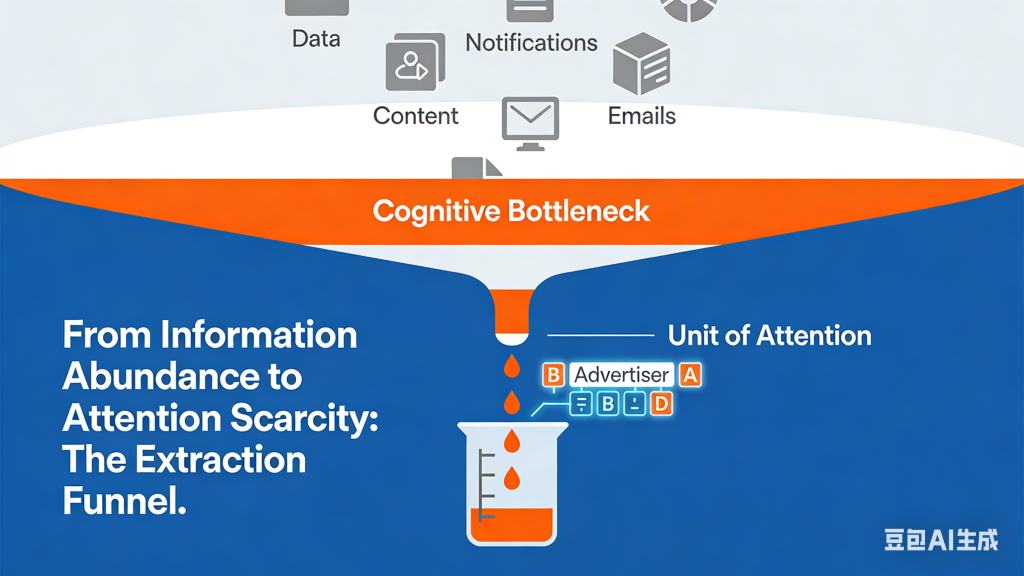
I. The Commodification of Cognition: Defining a Scarce Good
To model attention economically, we must first define its parameters. Attention is the behavioral manifestation of cognitive focus, a bottleneck through which the brain processes the world’s overwhelming data stream. Its defining characteristic is absolute scarcity. As psychologist and economist Herbert Simon presciently noted, “a wealth of information creates a poverty of attention.” An individual’s daily cognitive budget is fixed; a minute devoted to one stimulus cannot be reclaimed for another. This scarcity is intensified by the near-zero marginal cost of producing and distributing digital information, creating a radical supply-demand imbalance.
This cognitive good exhibits distinct market properties:
- Perishability: A unit of attention not captured is instantly and permanently lost, creating immense pressure for real-time capture mechanisms.
- Context-Dependent Valuation: Its value is not intrinsic but derived from the viewer’s demographic, intent, and emotional state. The attention of a luxury car enthusiast on an automotive review is orders of magnitude more valuable than that of a casual scroller.
- Asymmetric Information and Measurement: Sellers (platforms) possess vast data on attention quality (dwell time, engagement depth), while buyers (advertisers) often rely on proxy metrics, leading to complex valuation models.
The business of digital media, therefore, is not primarily content delivery but attention arbitrage: acquiring this cognitive resource at a low average cost and reselling it in targeted bundles at a premium.
II. The Extraction Engine: Platforms and the Production Function of Attention
Platforms like Meta, TikTok, and YouTube are best understood as industrial-scale attention refineries. Their production function has two primary inputs: user time and algorithmic curation. The output is quantified, predictable, and segmentable attention inventory. The core technological innovation enabling this market is the recommendation algorithm, a system designed to maximize “engagement”—a proxy for attention capture.
Research into these systems reveals their economic logic. An optimal platform algorithm, as analyzed in studies of content distribution, does not simply match users with their stated preferences. It dynamically experiments to identify content that maximizes total time-on-platform, often prioritizing emotionally resonant, provocative, or socially validating material. This creates a feedback loop: the algorithm learns which stimuli best extract attention, creators produce to those specifications, and users’ consumption patterns are subtly shaped, expanding the total addressable attention pool. The platform’s asset is not its content library but this finely tuned, reflexive system of extraction.
III. Pricing the Unpriceable: Auction Markets and Derived Demand
Unlike traditional commodities, attention lacks a spot price. Its value is realized through a derived demand market, primarily online advertising. Here, the dominant pricing mechanism is the real-time, automated auction. When a user opens an app, an unseen auction occurs in milliseconds among advertisers bidding for that specific individual’s next cognitive moment.
The price is determined by a multi-variable function: the advertiser’s bid, the predicted probability of a desired action (click, conversion), and the platform’s quality score (maintaining user experience to preserve long-term attention supply). This system, perfected by Google and Facebook, creates extraordinary price discrimination. Two users seeing the same ad slot may represent vastly different costs based on their inferred economic potential. This hyper-efficiency for advertisers turns the nebulous resource of attention into a precisely allocable, performance-driven capital good.
IV. Content in the Attention Factory: From Art to Asset
Within this model, the role of content is transformed. It is the fuel for the attention engine, and its form evolves to maximize catalytic efficiency. We observe several strategic adaptations:
- Format Optimization for Cognitive Capture: Content formats compress meaning to outpace the user’s scroll velocity. The rise of short-form video, stories, and thumb-stopping visuals represents an evolutionary arms race for the lowest cognitive acquisition cost.
- The Rise of “Structured Data” as a Secondary Market: A fascinating development is the valuation of content not for direct human consumption, but as training data for artificial intelligence. As noted in analyses of media licensing, companies like OpenAI and Anthropic seek vast corpora of professionally edited text and video. Here, content is an asset not for the attention it garners, but for the structured knowledge it contains—a pure capital good in the AI production chain.
- The Creator’s Dilemma: Individual creators operate as mini-firms within the platform’s market. Their success depends on reverse-engineering the algorithmic demand curve, often sacrificing creative integrity for “algorithm-friendly” tropes. The economic rewards are power-law distributed; a tiny minority capture the majority of monetizable attention, replicating winner-take-all market dynamics.
V. Market Failures and Externalities: The Costs of an Attention Economy
An unregulated market for a cognitive resource generates significant negative externalities, pointing to systemic failures:
- Attention Depletion and Cognitive Pollution: The competition for focus incentivizes the overproduction of addictive, low-value information, creating a “tragedy of the cognitive commons” where the individual’s mental space is degraded.
- Behavioral Manipulation and Asymmetric Power: Platforms’ superior knowledge of human cognitive biases (e.g., variable rewards, social comparison) allows them to design ever-more efficient extraction interfaces, raising ethical concerns about autonomy and manipulation.
- Erosion of Public Sphere Quality: When attention is the sole metric, civic or complex informational content cannot compete with sensationalist material, undermining the democratic function of media.
These externalities suggest that the attention market, left to its own logic, may not arrive at a socially optimal allocation of our most precious cognitive resource.
Conclusion: Toward a New Political Economy of Focus
Modeling attention as a scarce commodity demystifies the core revenue engine of the digital age. It reveals a world where human experience is parsed into tradable cognitive units, where creativity is incentivized by algorithmic demand signals, and where market structures are built around the continuous auction of our moments. This framework is indispensable for regulators seeking to mitigate externalities, for investors valuing platform companies, and for citizens understanding the forces shaping their daily consciousness. The central challenge ahead is not technological but socio-economic: devising governance models, perhaps drawing from resource economics or public goods theory, to steward our collective attention with the care befitting a non-renewable resource essential to human flourishing. The market for attention has been built; now, we must decide how to manage it.






Discuss