
Let’s speak frankly. The boardroom buzzwords—”Industry 4.0,” “smart factory,” “digital transformation”—often feel abstract, promising future returns on daunting upfront investments. But a concrete, value-driving convergence is now moving from pilot projects to balance sheets: the integration of Artificial Intelligence with real-time, high-fidelity Digital Twins. This isn’t just about visualization; it’s about installing a central nervous system and a predictive brain for your entire industrial operation. The result, as early adopters are proving, isn’t marginal improvement but fundamental process reinvention with efficiency gains and cost reductions consistently exceeding 30%.
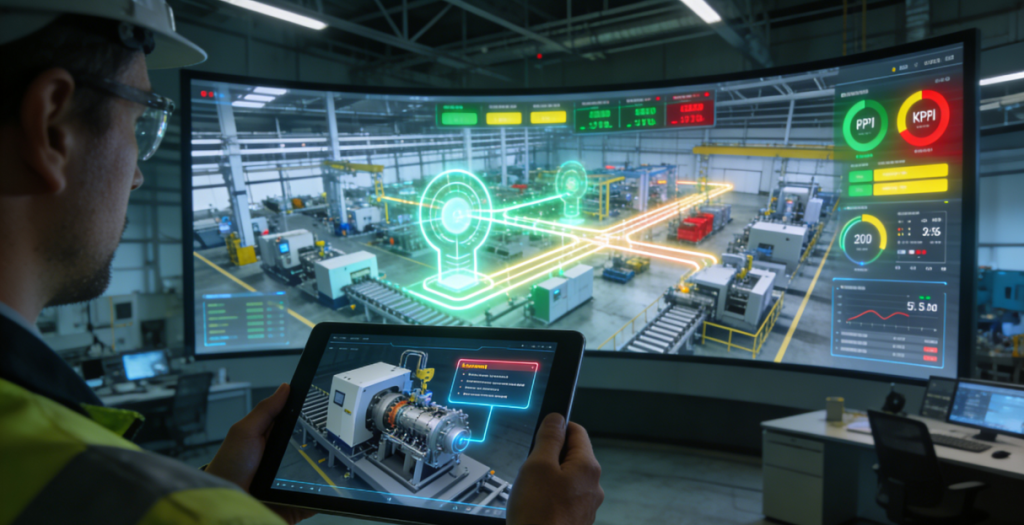
A Digital Twin, at this new level, is far more than a static 3D model. It is a live, data-fed, physics-informed virtual replica of a physical asset, production line, or even an entire supply chain. It ingests torrents of real-time data from IoT sensors, control systems, and ERP/MES platforms. The revolutionary leap comes when this dynamic twin is married with AI and machine learning algorithms. The AI acts as the twin’s cognitive engine, continuously analyzing this data stream to not only mirror reality but to simulate, optimize, and prescribe.
This synergy is transforming three core pillars of industrial management:
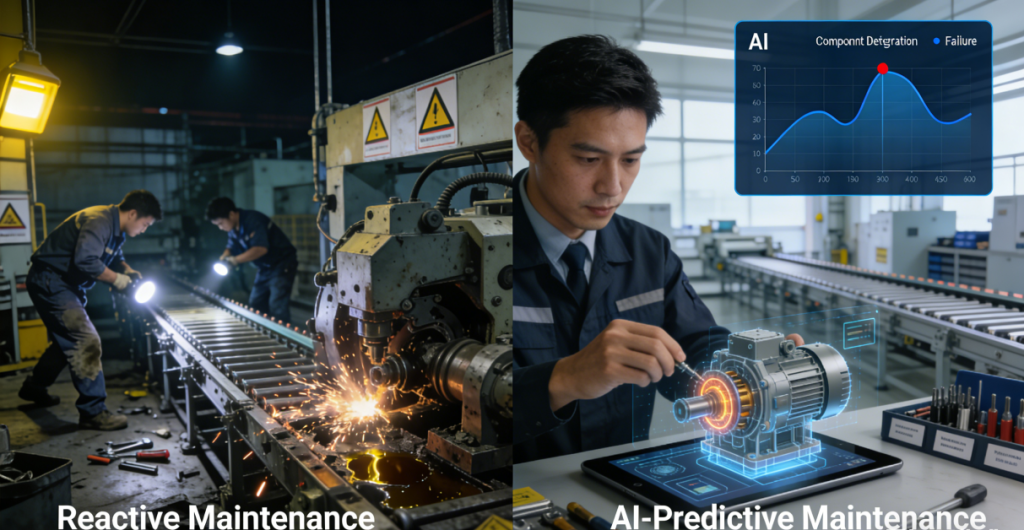
First, Predictive Maintenance & Asset Performance. The reactive “run-to-failure” model is a costly relic. An AI-driven twin models the precise degradation curves of critical equipment—a compressor, a CNC spindle, a reactor vessel. By analyzing operational data against this digital model, it can foresee a bearing failure weeks in advance, prescribing specific maintenance actions. One global chemical manufacturer implemented this on their cracking units, reducing unplanned downtime by 45% and extending mean time between failures by over 30%. The AI doesn’t just predict; it learns from each event, making its future forecasts more precise.
Second, Process Optimization at Systemic Scale. Historically, tuning a complex production line was a game of isolated adjustments, often creating bottlenecks elsewhere. An enterprise-scale digital twin, powered by AI, allows for holistic simulation. You can test the impact of a raw material change, a new shift pattern, or an altered energy tariff in the virtual world before committing physical resources. A leading automotive battery cell producer uses this to simulate thousands of electrode coating recipes digitally, accelerating formulation development by 70% and slashing material waste. The AI identifies non-intuitive optimal setpoints that human operators would never deduce, squeezing out every percentage of yield and energy efficiency.
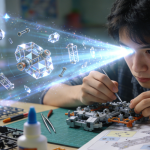
Third, Human Capital Augmentation & Training. The frontline engineer is empowered, not replaced. Using an AR interface linked to the digital twin, a technician can see real-time performance data and AI-generated guidance overlaid directly on the physical machinery. For training, new operators can practice procedures, respond to simulated emergency scenarios, and learn the intricacies of plant operations in a risk-free, photo-realistic virtual environment. This drastically reduces training time, improves safety records, and elevates workforce capability.
The pathway to this ROI is methodical. It starts with a high-value asset or bottleneck line. The key is data liquidity—breaking down silos so operational technology (OT) data flows seamlessly into the IT realm where the twin resides. Partners like Siemens, Microsoft, and NVIDIA are offering scalable industrial metaverse platforms that make this integration more pragmatic than ever.
“An AI-enhanced digital twin is the ultimate business planning tool,” states the COO of a multinational aerospace supplier. “We’re no longer managing our facilities based on last month’s reports. We’re steering them with a continuously updated, forward-looking simulation of performance. It has moved from a capital expenditure to a core strategic asset.”
The future is autonomous optimization. The next phase is closed-loop systems where the AI, through the twin, doesn’t just recommend actions but automatically implements them—adjusting setpoints, rerouting workflows, or managing energy consumption in real-time to meet dynamic objectives.
For the industrial leader, the equation is now clear. The convergence of Digital Twin and AI is not an IT project; it is a competitive imperative. It delivers the holy grail: unprecedented visibility, predictive certainty, and holistic efficiency. The 30%+ gains are not hyperbole; they are the new benchmark for those willing to operationalize their data and let their factory’s digital shadow light the way.



Discuss