We are living in an age of the perpetual lease. The refrigerator that alerts you to low milk, the car that warms your seat for a monthly fee, the software that powers your creative work—increasingly, these are not products you own, but services you rent. The subscription model, once confined to periodicals and utilities, has metastasized into a universal business logic, promising frictionless access and freedom from the burdens of ownership. This paradigm is marketed as a victory for consumer convenience and flexibility. Yet, a closer economic examination reveals a more concerning reality: the systematic erosion of consumer sovereignty. By transforming discrete purchases into open-ended service relationships, the subscription economy is constructing a marketplace defined not by liberation, but by behavioral lock-in, obscured total costs, and a fundamental shift in market power from the buyer to the seller. We are not merely choosing a new way to pay; we are consenting to a new architecture of control.
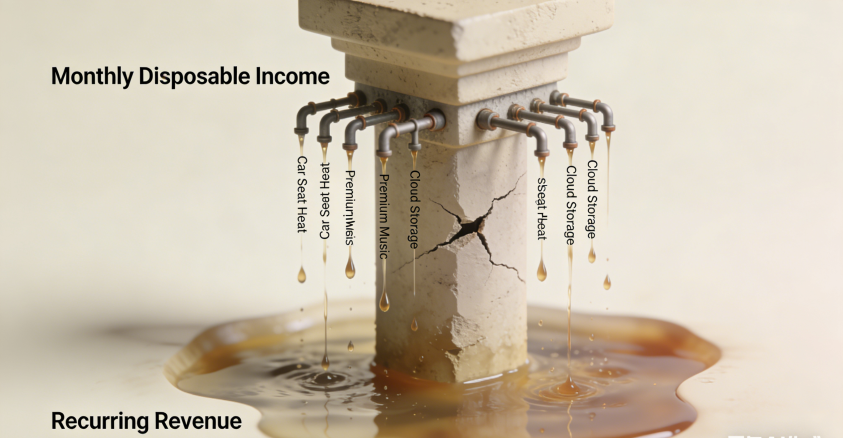
The central allure of the subscription—low upfront cost and seamless convenience—acts as a potent behavioral Trojan horse. It exploits well-documented cognitive biases, notably present bias and loss aversion. The immediate gratification of accessing a premium car feature or professional software for a small monthly sum feels insignificant compared to a daunting lump-sum payment. However, this obscures the long-term financial reality. The cumulative cost of a subscription almost always eclipses the outright purchase price over a moderate time horizon, a phenomenon economists term “subscription creep.” The consumer trades capital expenditure for a perpetual operational cost, diminishing their financial flexibility. More insidiously, the model creates high switching costs. Leaving a platform means not just losing a service, but often losing access to one’s own data, creations, or established workflows. This isn’t just an inconvenience; it’s a form of digital captivity, where the hassle of leaving is engineered to outweigh the dissatisfaction of staying.
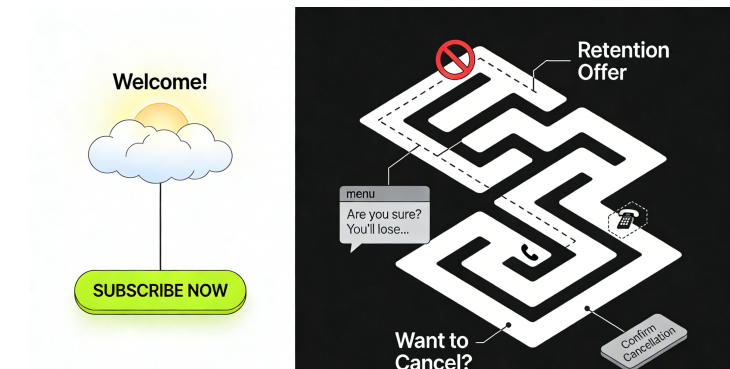
This architecture of entrapment is often built using “dark patterns”—deliberate UX designs that manipulate choice. Studies, including those by national consumer protection agencies, find these patterns ubiquitous, with companies making cancellation processes deliberately arduous. The path to subscribe is a single click; the path to cancel is a labyrinth of retention offers, guilt-tripping confirmations, and hidden menu options. This asymmetry is not a bug but a feature, designed to exploit inertia and convert fleeting intent into permanent revenue. The result is “subscription sprawl”—a portfolio of dozens of small, auto-renewing charges that bleed personal budgets dry through a thousand tiny cuts, creating a fog of financial commitment that is extraordinarily difficult to audit or escape.
The economic consequences extend beyond individual wallets to distort the very fundamentals of market competition. In a healthy market, producers compete on quality, innovation, and price to win discrete sales. The subscription model changes the competitive vector to “engagement maximization” and “churn minimization.” Success is measured not by making a better product, but by making an indispensable one—or more accurately, one that is too cumbersome to abandon. This can lead to perverse innovation: investments in features that increase switching costs (proprietary data formats, closed ecosystems) rather than those that improve core utility. It incentivizes “enclosure” of previously open markets, as seen in software where standalone tools are bundled into monolithic, all-or-nothing suites. This stifles niche competitors and reduces true consumer choice, as the battle shifts from competing products to competing, walled gardens.
Perhaps the most profound, and least discussed, shift is the transformation of the consumer from a buyer to a data subject and perpetual tenant. A purchased product implies a concluded transaction. A subscription implies an ongoing relationship, granting the company a continuous license to monitor usage, harvest behavioral data, and adjust terms. Your interaction with a subscribed car or smart appliance becomes a stream of monetizable telemetry. This data not only fuels further targeted engagement but can also be used to dynamically adjust pricing or access—imagine insurance-linked subscription rates for car features or tiered software access based on usage profiles. The promise of “updates” becomes a double-edged sword; it can deliver improvements, but it can also remove features, alter interfaces, or change privacy policies at the provider’s whim. You own nothing, and you are always one update away from a degraded service.
The endpoint of this logic is a market where access is conditional and ownership is obsolete. It represents a quiet transfer of power, risks, and rights. Consumers bear the cumulative financial cost and the risk of service alteration or termination, while forfeiting the rights that come with ownership: to repair, to resell, to use indefinitely, and to modify. Companies, meanwhile, gain predictable revenue, valuable behavioral data, and unprecedented control over their product’s lifecycle and their customer’s experience.
To reclaim sovereignty, consumers and regulators must move beyond the seductive narrative of convenience. This requires radical transparency mandates forcing clear disclosure of long-term costs and easy, symmetrical cancellation. It demands interoperability rights that allow users to extract and transfer their data, lowering switching costs. It calls for a renewed cultural and legal defense of ownership, recognizing the property right in a purchased good as a crucial bulwark against commercial overreach. The subscription trap is not inevitable; it is a design choice. The true measure of a market’s health is not the volume of recurring charges, but the preserved freedom of the consumer to walk away.






Discuss