
For three decades, the dominant paradigm of global economics was one of convergence—a steady, if uneven, integration powered by the free flow of goods, capital, and ideas across borders. This model promised, and often delivered, efficiency, growth, and interdependence so deep it was thought to make conflict prohibitively costly. That era is decisively closing. We are not witnessing a simple reversal, a binary “decoupling,” but a more complex and profound process: The Great Fragmentation. Driven by resurgent geopolitics, national security imperatives, and a reaction to concentrated supply chain vulnerabilities, the integrated global economy is being rewired into a system of competing, partially insulated blocs. This shift from a single, interconnected web to a cluster of distinct spheres of influence will redefine the rules of trade, redirect the flow of capital, and reshape the trajectory of innovation for decades to come.
The catalyst for this fragmentation is the collapse of the foundational assumption that economic logic invariably trumps political rivalry. Strategic competition, particularly between the United States and China, has ceased to be a compartmentalized issue and has instead become the organizing principle of economic policy. This is no longer about tariffs on specific goods; it is about the weaponization of interdependence. The use of export controls on advanced semiconductors, restrictions on outbound investment in critical technologies, and the crafting of “friend-shoring” initiatives explicitly tie commercial activity to geopolitical alignment. These actions are not temporary protectionism but the architectural blueprints for new economic walls. As one European trade commissioner recently noted, “We have moved from managing globalization to managing de-risking. The question is no longer how to connect, but what to connect, and with whom.”
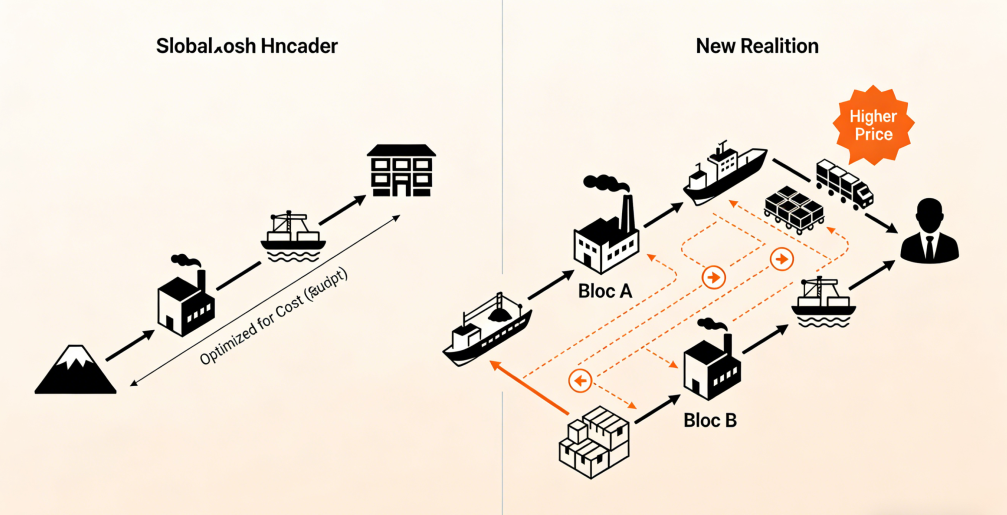
This is giving rise to a discernible, if still-fluid, tripolar structure. The first bloc, centered on the U.S.-European techno-democratic alliance, is coalescing around shared values, deep capital markets, and a coordinated approach to limiting technological leakage to strategic adversaries. Its toolset includes the CHIPS and Science Act, the EU’s Economic Security Strategy, and a network of alliances like the G7. The goal is to maintain a decisive lead in foundational technologies (AI, biotech, quantum) and secure supply chains for critical materials, even at a higher cost.
The second is the China-centric sphere, anchored by the world’s largest manufacturing ecosystem and bolstered by initiatives like the Belt and Road. Facing export controls and investment barriers, this bloc is prioritizing self-reliance (“dual circulation”) and deepening economic diplomacy with the Global South. It offers an alternative model of development finance, infrastructure, and technology transfer—one less encumbered by political conditionalities—creating a parallel network of trade and influence.
The third, and most heterogeneous, is the strategic swing bloc of the Global South. Nations from Brazil to India to Indonesia are refusing to be forced into a binary choice. They are pragmatically engaging with all sides, leveraging their market size, resource wealth, and strategic geography to extract maximum benefit. For them, fragmentation presents an opportunity: to demand better terms for their commodities, to attract diversified manufacturing (“China+1”), and to position themselves as indispensable nodes in multiple, competing supply chains. Their allegiance is not ideological but transactional, making them the pivotal arbiters in this new economic order.
The long-term implications of this fragmentation are multidimensionally inflationary. First, it introduces permanent efficiency losses. The re-routing of supply chains away from optimal, cost-based locations to politically acceptable ones is a tax on productivity. Duplication of production capacity—building “just-in-case” inventories and parallel manufacturing bases—locks in higher costs. This structural shift contributes to stickier inflation, constraining central banks and lowering potential growth rates.
Second, it threatens to balkanize innovation. The open exchange of ideas and talent that accelerated the digital revolution is being replaced by a guarded, proprietary approach to research. While competition can spur progress, the erection of high walls around scientific collaboration risks creating competing technological standards (e.g., in AI ethics or 6G networks) and slowing the overall pace of discovery. The global pool of knowledge is being partitioned into smaller, less dynamic ponds.
Third, it creates a new landscape of asymmetric vulnerabilities. Bloc leaders will seek to monopolize control over critical choke points, not just in physical resources like rare earths, but in the virtual layers of the economy: cloud infrastructure, payment systems, and data streams. This transforms economic statecraft into a constant game of leverage, where sanctions, digital embargoes, and platform denials become standard tools, increasing systemic volatility.
The endgame of this Great Fragmentation is not a return to autarky. It is the emergence of a conditional, politicized globalization. Goods, capital, and data will still flow, but their paths will be determined by algorithmic rules of origin, security clearances, and geopolitical compatibility checks. Corporations will need to maintain parallel supply chains and balance sheets, navigating an ever-thickening undergrowth of compliance. The “global” market will increasingly be a series of connected but distinct domains, each with its own rules of entry.
This transition carries profound risk. It could cement a world of lower growth, higher prices, and entrenched technological divides. Yet, within the friction, there is also the potential for a more resilient, if less efficient, system—one where redundancy replaces hyper-optimization, and where regional stability is valued alongside quarterly returns. The task for policymakers and business leaders is no longer to mourn a bygone era of integration, but to navigate the turbulent currents of a world where economics has been, and will remain, fundamentally and irrevocably political.








Discuss